
The software industry is in the middle of its biggest transformation since the cloud. Artificial Intelligence, once a lab experiment, has become the driving force behind how modern code is written, tested, deployed, and delivered. What was once innovation is now infrastructure.
To understand this shift, ITProfiles spoke with 20 CEOs and senior tech leaders from around the world, from product studios and software houses to AI-first consultancies, to uncover how AI is reshaping their businesses, their teams, and their clients’ expectations.
These companies represent 14 countries across Europe, Asia, North America, Africa, and Oceania, together employ thousands of technocrats, and have implemented AI not only for client projects but also as part of their culture. They are witnessing what's changing and are in the right position to analyze what's coming.
These conversations reveal a moment of quiet revolution. AI isn’t just accelerating development; it’s redefining what development means. It’s changing how software is imagined, who builds it, and what clients expect from it. And while the hype around AI remains loud, these voices show a more grounded reality - one built on lessons, experiments, and lived experience.
Across the insights, a few themes consistently surfaced:
Productivity and precision - AI is cutting through repetition and unlocking efficiency.
Collaboration over automation - humans and AI are learning to co-create.
Shifting roles - developers are evolving into strategists and architects.
Ethical and operational challenges - innovation balanced with responsibility.
New client expectations - faster, smarter, more personalized outcomes.
The road ahead - a future shaped by custom AI, governance, and creativity.
This is not a story about machines replacing people. It’s about humans leveraging intelligence, natural and artificial, to build a smarter digital world.
In the sections that follow, we distill the key takeaways from these 20 conversations - an inside look at how AI is transforming software development and what it means for the future of IT services.


Find My Agency Takes only 2 mins, 100% free
 Table of Content
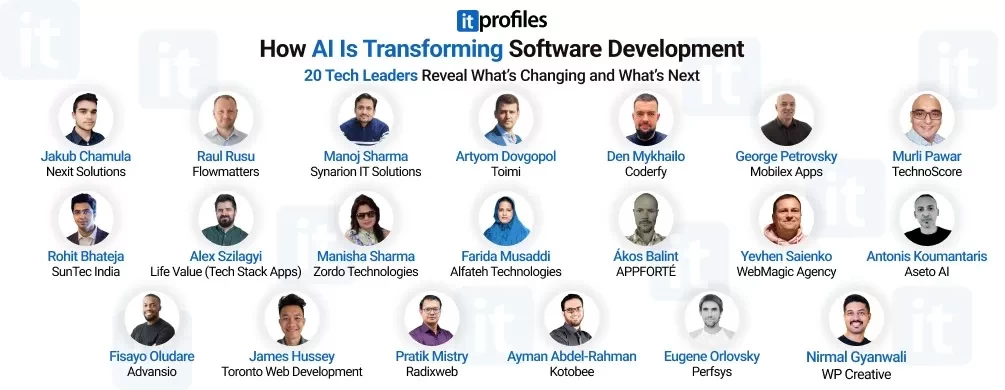
20 Tech Leaders Reveal What’s Changing and What’s Next
Across our recent conversations with tech CEOs and leaders from around the world, one theme echoed louder than any other - AI is no longer an experiment sitting in the corner of R&D. It has become the core engine of modern software development, shaping how code is written, tested, deployed, and even imagined.
AI is no longer a tool, it's a teammate.
Just a year or two ago, many firms viewed AI as a useful productivity add-on - a “nice to have” innovation to test on select projects. Today, that mindset has shifted dramatically. These leaders describe a world where AI is now deeply embedded in everyday workflows, from automating test coverage and generating code snippets to predicting project bottlenecks and supporting smarter decision-making.
“For us, AI isn’t a side feature anymore. It’s part of how we design, code, and deliver from day one.” - Jakub Chamula, Nexit Solutions
“We’re not talking about tools that help; we’re talking about systems that think with us.” — Raul Rusu, Flowmatters
This isn’t about hype cycles or shiny new tools - it’s about real operational change. Agencies that once prided themselves on development speed now talk about AI as the difference between staying relevant and falling behind.
The tone of the industry has matured: experimentation has turned into integration, and curiosity into capability.
“You can’t plug in AI and expect transformation. It works only when the culture is ready for it - when teams are open to learn, test, and fail,” noted Eugene Orlovsky, CEO of Perfsys.
Many of these leaders also highlighted a subtle but powerful mindset shift: the goal isn’t to “automate everything,” but to elevate the role of human developers. AI is seen as a collaborator that handles the heavy lifting, freeing teams to focus on higher-order creativity and strategy.
The story is similar for Artyom Dovgopol, Toimi, who has seen AI become part of every step of the company’s process:
“AI has become a natural extension of how we approach projects — helping us test ideas faster, write better code, and deliver smarter results.”
Even smaller, newer firms like Coderfy are seeing measurable gains.
“We started with internal tools that helped us automate project management and pre-sales,” explained Den Mykhailo, Coderfy. “Today, we use AI to accelerate entire processes - from concept validation to accounting.”
These examples reflect the same pattern repeated across industries and company sizes: AI is no longer optional. Whether it’s for predictive testing, intelligent code review, or automated documentation, it’s already transforming core development workflows.
The software world is standing at a new threshold - one where AI isn’t replacing developers but redefining what development itself means. In the next section, we dive into the early wins: how these companies are already seeing measurable productivity and precision gains across their workflows.
If there’s one area where every leader we interviewed agreed, it’s that AI’s first wave of transformation has been astonishingly practical.
Forget the buzzwords - the most tangible impact of AI in software development today is about doing the same work faster, cleaner, and smarter.
Across the 20 companies we spoke with, nearly all described how AI has cut through repetitive or low-value development tasks, freeing engineers to focus on design, logic, and user experience. The consensus is clear: AI is the new accelerator pedal for productivity and precision.
“In our experience, code review and testing have seen the biggest improvements from AI tools,” shared Jakub Chamula, Nexit Solutions. “It’s not about shortcuts; it’s about precision and consistency that humans alone can’t maintain at scale.”
At Flowmatters, CEO Raul Rusu described how AI began as a set of experiments in 2020, automating analytics dashboards and small code generation tasks, and has since evolved into a critical layer of their delivery pipeline. “AI handles the routine so our developers can think,” he said.
Synarion IT Solutions found a similar pattern. CEO Manoj Sharma explained,
“AI assists in generating and optimizing code, automating documentation, and supporting smarter quality assurance. It helps us maintain the same level of accuracy while drastically cutting time.”
Alex Szilagyi, CEO of Life Value (Tech Stack Apps) agrees that AI’s early value wasn’t just in cutting time. “It gave us better visibility into our own process,” he said, “and that made every decision more grounded.”
“We began exploring AI by integrating it into our data analysis and QA testing. At first it was about speed, but we quickly saw how much it improved decision-making.”
What’s remarkable is that these benefits go beyond coding. AI is reshaping how entire projects flow. Several respondents highlighted improvements in testing, debugging, and even client communication, where AI-generated summaries, documentation, and predictive analytics reduce friction and errors.
Artyom Dovgopol of Toimi emphasized that speed alone isn’t the story - reliability is:
“AI has made our working process faster, but also more predictable. We can forecast development issues early and avoid last-minute surprises.”
Den Mykhailo of Coderfy added that AI is streamlining even non-technical aspects:
“Pre-sale, accounting, project management - these are now AI-assisted. It’s not just developers; the whole organization becomes smarter.”
These early success stories reveal that the real breakthrough of AI isn’t in revolutionary leaps, but in thousands of micro-improvements across workflows. Automation, pattern recognition, and instant feedback loops are quietly rewriting the economics of software projects - turning hours of work into minutes, and uncertainty into measurable confidence.
In this new phase, productivity is no longer about how fast teams can code, but how intelligently they can collaborate with AI.
While every company’s path to AI integration has been different, the first results have been surprisingly consistent - faster cycles, cleaner code, and sharper accuracy. These early wins are what turned initial curiosity into long-term commitment.
Several leaders mentioned that AI-powered code reviews and automated testing have dramatically reduced human error and project delays. For some, what once took an entire sprint can now be done overnight.
“Our biggest efficiency gain has been in code generation and bug detection,” said Manoj Sharma, Synarion IT Solutions. “AI helps generate and optimize code faster, but it’s the self-checking ability that really saves us time.”
Others highlighted that AI has changed quality assurance into a proactive process rather than a reactive one.
“AI spots anomalies and regression patterns before we even hit manual QA,” noted one leader. “It’s like having a second set of eyes that never gets tired.”
At Flowmatters, the AI rollout started in analytics and automation but has since expanded deeper into the development pipeline.
“We’ve seen the biggest improvements in areas that require repetitive analysis - data cleaning, performance audits, even frontend validation,” said Raul Rusu.
Smaller agencies are also seeing measurable operational gains. Den Mykhailo, Coderfy, explained how automation has multiplied their efficiency across unexpected areas.
“We use AI for pre-sales, accounting, and internal task management - all of which saves hours that can now go into development and design.”
Meanwhile, Artyom Dovgopol, Toimi, pointed out that even creative aspects of the workflow are now being assisted.
“AI doesn’t just code faster, it helps us explore options faster - for architecture, UX, and testing. It’s like compressing three review sessions into one.”
Some put precision ahead of speed, like Nirmal Gyanwali of WP Creative, “Speed isn’t the story. Precision is. AI lets us deliver smaller features faster, test them smarter, and adapt continuously.”
Beyond speed, precision is the keyword that keeps surfacing. With AI handling documentation and repetitive technical tasks, teams are delivering cleaner builds and more consistent deployments. For several agencies, this has led to improved client satisfaction and reduced technical debt.
“AI doesn’t get bored,” joked one founder. “It keeps standards the same at 6 p.m. as at 9 a.m. - and that’s priceless for quality.”
These early gains aren’t just about technology - they’re reshaping how development teams operate, plan, and measure success.
AI’s promise has moved beyond hype - it’s delivering tangible, bottom-line results. But as these leaders point out, its true potential lies not just in efficiency, but in how humans and machines now work together.
Share your project details with us for free, and get matched with experienced providers. Use our insights and expert recommendations to confidently choose the right partner for your needs.
The most profound shift brought by AI isn’t in the tools themselves - it’s in the relationship between humans and machines. The leaders we interviewed consistently described a new kind of workflow emerging, one that blends human creativity with machine precision.
In this evolving model, AI is less an assistant and more a collaborator. Developers are no longer simply writing every line of code - they’re shaping, prompting, and curating what AI produces. The craft of development has become as much about direction and judgment as it is about syntax.
“Even in an AI-first development world, human developers remain the architects,” said Raul Rusu, Flowmatters. “AI can help build, but it doesn’t understand the ‘why’ behind what it’s building.”
This idea, that human insight defines the purpose while AI handles the execution, came up again and again. CEOs talked about the rise of the AI-augmented developer, someone who understands both technology and intent.
At Synarion IT Solutions, Manoj Sharma described it as “creative problem-solving multiplied by automation.”
“AI can generate code but humans give that code direction and meaning. It’s about knowing when to use AI and when to think beyond it.”
For many agencies, this collaboration is not just about efficiency - it’s redefining culture. Developers are learning to ask better questions, to treat AI as a brainstorming partner rather than a black box. Teams are spending less time typing and more time designing, reviewing, and refining ideas.
At Toimi, Artyom Dovgopol explained that AI has changed team dynamics entirely:
“We now work in shorter cycles, because AI can generate options so quickly. It’s like having a permanent think tank inside the team.”
This shift also demands new skills - prompt engineering, data literacy, and AI-critical thinking. As AI becomes more integrated, the best developers aren’t those who resist it, but those who can guide it with clarity and purpose.
This is the quiet revolution happening in development teams worldwide: human creativity amplified, not replaced. AI is becoming the ultimate colleague - tireless, fast, and analytical - but still dependent on human intuition and context. The companies that thrive will be those that treat this collaboration not as automation, but as co-creation.
The rise of AI in development isn’t just a technical upgrade. It’s changing how people think, work, and interact inside teams. The leaders we spoke with described this shift as a quiet but fundamental evolution - from coding alone to co-creating with intelligence.
“Even in an AI-first development world, human developers remain the architects,” said Raul Rusu, Flowmatters. “AI can help build, but it doesn’t understand why it’s building.”
For many, that’s the real point. AI doesn’t replace creativity. It expands it.
“We see AI as a co-thinker. It handles the heavy lifting so people can focus on what they do best - imagination and intent,” echoed Ayman Abdel-Rahman, CEO of Kotobee.
Teams are learning to work with AI tools almost like creative partners - giving prompts, testing hypotheses, asking “what if” questions. Developers aren’t typing as much, but they’re thinking more.
Manoj Sharma, Synarion IT Solutions, put it simply:
“AI can generate code, but humans give that code direction and meaning.”
At Toimi, Artyom Dovgopol described how this collaboration changes the rhythm of projects.
“We work in shorter cycles. AI can generate three or four solutions instantly. That means we test faster, iterate faster, and learn faster.”
There’s a growing sense among these leaders that AI is becoming a kind of creative mirror. It reflects what you ask for - but the clarity of that reflection depends entirely on how well you frame the question. Developers are becoming more like designers, curators, and editors. The code is no longer the end product. The decision is.
Den Mykhailo, Coderfy, highlighted this shift in perspective:
“AI helps our developers think differently. Instead of solving every small task, they focus on structure, patterns, and innovation. It’s like moving from craftsmanship to direction.”
That requires new habits. New instincts. And new humility.
Many teams found that early experiments with AI only worked when developers stopped fighting the tool: when they started guiding it instead.
“You have to trust it just enough,” said one founder, “but not so much that you stop thinking.”
Training has become as much about mindset as skill. Agencies are now teaching their teams how to write prompts, evaluate AI outputs, and cross-check generated logic. Jakub Chamula, Nexit Solutions, calls it “the rise of the AI-literate developer.”
“It’s not about knowing every framework anymore. It’s about knowing how to steer intelligence.”
The tone across these interviews is pragmatic, not starry-eyed. AI doesn’t make developers obsolete. It forces them to evolve.
Humans define intent. Machines execute it. Together, they create something neither could achieve alone.
This is the new workflow. It’s not man versus machine. It’s man with machine, at full speed.
AI isn’t just transforming workflows - it’s reshaping the very roles within software teams. What once defined a good developer - speed, syntax mastery, and meticulous debugging - is now being replaced by strategic thinking, problem framing, and creative system design.
Across nearly every interview, leaders emphasized one truth: AI handles execution, but humans handle direction. This is turning developers, testers, and project managers into strategists - people who think more about why and what to build, not just how.
“AI can take care of repetitive logic,” said Jakub Chamula, Nexit Solutions. “That means developers now have to think like architects - how systems connect, how data flows, how to create long-term value for clients.”
For many agencies, this shift has sparked an internal evolution in skill-building. Teams are being trained not just in frameworks and languages, but in AI literacy, data understanding, and ethical awareness. The goal is to grow engineers who can interpret AI outputs critically, spot flaws, and steer them toward business goals.
“We invest heavily in upskilling,” shared Manoj Sharma, Synarion IT Solutions. “Developers are learning machine learning basics, model prompting, and how to evaluate AI-generated results. The new job is part engineer, part analyst, part product thinker.”
At Flowmatters, Raul Rusu observed that the real challenge isn’t technical - it’s cultural.
“Preparing teams for AI isn’t just about tools, it’s about mindset. We’re training people to see AI as a creative collaborator, not a competitor.”
Toimi’s Artyom Dovgopol echoed this, noting that creativity has become the new metric of success:
“Our best developers are the ones who can adapt fast, experiment with AI tools, and find unconventional uses for them. They’re not afraid to rethink how projects start.”
AI is quietly elevating the expectations of human talent. Developers who once focused on writing perfect functions are now designing AI-informed architectures and advising clients on digital transformation strategy. The modern IT agency is becoming a hybrid of engineering and consultancy - where creativity, adaptability, and human insight define competitive advantage.
The future developer isn’t just building products - they’re building possibilities.
AI is not just changing how developers work, but how they think about their work. Across our interviews, many leaders emphasized that the biggest transformation is not in technology, but in mindset. Developers are stepping out of their traditional execution roles and becoming active participants in shaping product direction and business outcomes.
For Ayman Abdel-Rahman of Kotobee, AI isn't a replacement for creativity.
“AI isn’t a replacement for creativity; it’s a reflection of it. It gives you a hundred ideas, but only humans can tell which one matters.”
George Petrovsky of Mobilexapps described how this evolution has taken hold in his teams.
“Developers are spending less time on repetitive implementation. They’re now interpreting AI outputs, refining logic, and focusing more on architecture and client value.”
This view was echoed by Rohit Bhateja of SunTech India, who sees AI transforming what it means to deliver quality.
“AI has made our developers more strategic. They spend more time thinking about user impact and less time on syntax. It’s about how to use AI intelligently, not just efficiently.”
TechnoScore's Murli Pawar pointed out that AI has created an opportunity for people to grow beyond their core roles.
“AI has opened up time for reflection and design. Our engineers are learning to analyze problems differently. We discuss intent before implementation now.”
For Manisha Sharma, CEO of Zordo Technologies, AI has shifted not only project execution but also how teams communicate.
“Earlier, developers worked in silos. Now, they collaborate more closely with analysts and clients because AI gives them visibility into every part of the process.”
Several leaders spoke about how AI is encouraging developers to take ownership of decisions once reserved for managers or architects. Farida Musaddi, CEO of Dubai-based Al Fateh Technologies, described it as a “democratization of intelligence.”
“AI tools have made information transparent. Developers no longer wait for instructions; they question and contribute. It’s building confidence and accountability.”
Echoing this sentiment, Healthtech developer Alex Szilagyi of Life Value observed that AI has turned developers into forecasters rather than fixers. “It’s not about reacting to problems,” he said, “it’s about anticipating them.”
“AI has made developers more analytical. Instead of jumping straight into code, they now evaluate patterns and predict where issues might occur. It’s a shift from reacting to anticipating.”
This sentiment was shared by Yevhen Saienko of Webmagic, who sees AI reshaping hierarchy itself.
“AI has flattened teams. The person who understands how to work with AI effectively becomes the one driving ideas, regardless of title.”
Ákos Balint, Co-Owner of APPFORTÉ, noted that this change has required companies to rethink skill development.
“We’re teaching developers how to review AI-generated results critically. That’s now a core skill. You can’t just trust the tool, you have to guide it.”
At Aseto, AI has redefined what creativity looks like in development.
“Our engineers used to measure success in how much they coded. Now, it’s how well they can solve problems. The creative part is in designing smarter workflows.” Antonis Koumantaris - CPO, Aseto
Even within larger projects, this shift is visible. Fisayo Oludare, CEO of Advansio, observed that AI has allowed developers to move closer to the business layer.
“They’re not just implementing requirements anymore. They’re helping identify what the real requirements should be.”
And for James Hussey of Toronto Web Development, the transformation is personal. “AI has changed what it means to be good at this job. It’s not about knowing everything; it’s about knowing how to think with technology.”
Together, these voices reveal a consistent truth. AI is not replacing developers, it’s repositioning them - from builders to strategists, from coders to collaborators, from executors to enablers.
Developers are no longer the last step in the process. They’re helping define the first.
For all the optimism surrounding AI, every leader we spoke to had a reality check to share.
AI is powerful, yes - but it’s also unpredictable, biased, and occasionally wrong in ways that humans would never be.
The rise of machine assistance has opened a new front of ethical, technical, and operational challenges that most companies are only beginning to understand.
“The biggest challenge was trust,” admitted Jakub Chamula, Nexit Solutions. “You can’t blindly rely on AI’s output. It saves time, but it can also amplify errors if you’re not careful.”
Others pointed to a quieter, more complex issue - compliance and data security. AI thrives on data, yet in sectors like healthcare, fintech, and public services, data is guarded by regulation. Using AI models that learn from or store that data is walking a tightrope between innovation and liability.
Manoj Sharma of Synarion IT Solutions framed it bluntly:
“Quality and accuracy - those are our biggest concerns. We can’t just accept what AI produces. Every line of AI-generated code needs human review.”
There’s also the ethical dimension - one that doesn’t make headlines as often as productivity does. A few leaders raised concerns about explainability and fairness. How do you ensure your AI decisions are transparent? How do you prove to clients that your process is still human-led?
Raul Rusu of Flowmatters summed up this unease in one line:
“Adopting AI is less about technology and more about accountability. You need to know where responsibility begins and ends.”
And then there’s culture. The pressure to “go AI” can lead teams to rush implementation before readiness. Some agencies found that early experiments actually slowed delivery, as engineers spent time verifying AI outputs instead of coding from scratch.
Den Mykhailo, CEO of Coderfy, told us - half amused, half exasperated -
“At first, AI made our work slower. We had to learn how to trust it, test it, tame it.”
AI’s greatest gift - speed - is also its most dangerous temptation. The leaders ahead of the curve aren’t the ones adopting AI fastest, but those adopting it wisely.
They’re building internal review frameworks, ethics boards, and quality protocols that ensure AI never outpaces human judgment.
The story here isn’t fear. It’s a balance.
AI’s promise is enormous, but so is the responsibility that comes with it.
Innovation without integrity is just automation without purpose.
Every leader we spoke with agreed - AI brings power, but also pressure. The pressure to move faster, to deliver more, to seem ahead. Yet beneath the optimism, there’s a layer of caution. Because with every shortcut AI offers, there’s a question of what might be overlooked.
Rohit Bhateja of SunTec didn’t mince words. “AI can speed up development, but it can also multiply mistakes,” he said. “If your data or logic is even slightly off, the AI doesn’t fix it - it scales it.” His team learned that early. A model built for internal QA automation started flagging false positives faster than anyone could check them. What was meant to save time turned into a week of debugging.
For Dubai-based Farida Musaddi, the anxiety isn’t about bugs. It’s about privacy. She described the quiet tension every CTO feels when using third-party AI systems. “When AI connects to client data, even indirectly, you have to know where the boundaries are. One careless input can undo years of trust.”
Some leaders said the challenge isn’t technical at all. It’s behavioral. Yevhen Saienko of WebMagic called it “the myth of infallibility.” Teams, he said, often start assuming AI outputs are right simply because they look right. “We had to retrain people to doubt again,” he said. “To verify, to challenge, to remember they’re the human in the room.”
Others pointed to something subtler - the cultural fatigue that comes from chasing automation for its own sake. Manisha Sharma put it simply: “There’s this new pressure to prove you’re using AI everywhere. But not every problem needs it. Sometimes human judgment is faster.”
And then there’s the client side. Antonis Koumantaris explained how transparency has become a double-edged sword. “Clients love hearing we use AI,” he said, “until they realize it means rethinking timelines and expectations. They want the magic, not the process.”
For George Petrovsky, CEO of Mobilexapps, the main lesson has been restraint. “You can’t automate accountability,” he said. “Even if AI writes the code, you’re still responsible for the result.” His team now includes a human validation checkpoint for every AI-generated function, no matter how trivial it seems.
Akos Balint added that the early stages of AI adoption were slower than expected. “We thought productivity would skyrocket from day one,” he said, laughing. “Instead, we spent months just learning how to trust it without losing control.”
Every story points back to the same truth - AI doesn’t erase human judgment, it demands more of it. The technology accelerates everything, including the consequences of mistakes.
Toronto-based James Hussey captured it best. “AI won’t fix poor planning or bad communication,” he said. “If your process is broken, AI just breaks it faster.”
These are not complaints. They’re lessons written in production code and project timelines. This is what real adoption looks like - messy, unpredictable, deeply human.
AI may promise precision, but these leaders know: without discipline, precision is just another illusion.
If AI is transforming how developers work, it’s also reshaping what clients expect. The conversation has changed. Clients no longer ask if a company uses AI - they assume it does. What they care about now is how intelligently and responsibly it’s being used.
“AI is changing the way clients look at IT services,” said Raul Rusu, Flowmatters. “They expect speed, efficiency, and innovation - all at once. The bar has moved.”
Across our interviews, one pattern was unmistakable: clients expect more for less, and they expect it faster. Faster delivery cycles. Smarter estimates. Real-time progress insights. Some even demand AI-powered features built into their software from the very first proposal.
For Jakub Chamula at Nexit Solutions, the change was both subtle and seismic:
“Conversations with clients now start with strategy, not specs. They want to know how AI fits their business - not just their project.”
This expectation is forcing IT companies to evolve from mere implementers to strategic partners. The most successful agencies are not just coding solutions but consulting on transformation - helping clients understand where AI adds value and where it doesn’t.
At Synarion IT Solutions, Manoj Sharma noticed clients demanding AI-enabled transparency: dashboards that track quality, predict issues, and visualize progress in real time. “AI has raised the bar for reporting. Clients want visibility, not just results,” he said.
Others pointed out a more human shift: clients are now more skeptical. They know AI can accelerate delivery, so they expect lower costs. They also share concerns regarding accountability and data ethics.
“AI doesn’t remove humans from the loop - it increases the responsibility of those in it. The bigger the AI’s role, the more critical human reasoning becomes,” noted Pratik Mistry, EVP - Tech Consulting at Radixweb. “Clients often expect magic from AI. What they really need is clarity. Our job is to bridge that gap, to show that speed means nothing without understanding.”
But they also want reassurance that AI doesn’t compromise creativity, security, or originality. “Speed is good,” said Den Mykhailo, Coderfy, “but clients want something smart, not something fast. AI creates expectations of magic. It’s our job to bring them back to reality.”
AI has quietly rewritten the social contract between tech providers and their clients. It has created both opportunity and pressure - the expectation that agencies are not just builders but AI innovators and advisors.
Clients now measure value not just in lines of code, but in intelligence per project. They expect transparency, adaptability, and results that feel personalized - outcomes shaped by data, not just deadlines.
In the AI era, credibility comes not from promises, but from proof - and proof now lives in every AI-assisted line of work.
Clients are changing faster than the tools themselves. Every leader said it.
“AI has changed how clients see value. They don’t just want a finished product anymore - they want insights, predictions, and momentum,” cited Nirmal Gyanwali of WP Creative. The AI conversation isn’t confined to development teams anymore - it starts with clients, and it’s transforming how projects are scoped, priced, and delivered.
Many CEOs told us their clients now arrive expecting AI involvement. They assume automation is part of the process. They want smarter timelines, more transparency, and predictive accuracy. It’s no longer enough to build good software; now, firms must build intelligently.
Murli Pawar captured this shift well.
“AI has changed client conversations completely. They don’t want to know if you use AI, they want to know how. They expect it to make their projects faster, cheaper, and more precise - all at once.”
For Rohit Bhateja, this change brought a new layer of pressure. His clients want visible AI benefits, not abstract ones.
“Clients ask for shorter delivery cycles because they assume AI makes everything instant. It’s up to us to set realistic expectations without losing their confidence.”
That gap between perception and reality is where most friction now lives.
Alex Szilagyi of Romania-based app development agency Life Value countered the idea that AI automatically guarantees speed or perfection. “Clients often expect miracles,” he explained, “but what AI really delivers is process intelligence - value that grows over time.”
“Clients hear about AI and immediately expect miracles. It’s our job to guide them - to show that AI adds value through process, not magic.”
Farida Musaddi explained how her agency manages it by bringing clients into the workflow.
“We show them what AI does behind the scenes. When they see the checks, the iterations, they understand it’s not a magic button. It’s intelligence in motion.”
George Petrovsky described a similar strategy. Instead of hiding AI, his team makes it part of the client experience. “We share AI-generated reports, architecture drafts, and even model predictions. It creates trust because they see the logic evolve, not just the result.”
At the same time, AI has raised the quality bar dramatically. Clients are asking deeper questions. Antonis Koumantaris said the shift is subtle but unmistakable.
“They used to ask about deliverables. Now they ask about data sources, model accuracy, and validation. The conversation is smarter, more informed.”
That intelligence cuts both ways. Akos Balint mentioned that clients have become more skeptical, too. “They assume AI means faster turnaround, so they push harder on pricing,” he said. “We have to explain that human expertise still drives the outcome.”
For Fisayo Oludare, this shift has redefined what it means to offer value.
“Clients now see us as partners in innovation, not just service providers. They want us to guide them on where AI actually fits - and where it shouldn’t.”
Across interviews, the message is clear: AI has elevated expectations. Clients want speed without compromise, innovation without risk, intelligence without complexity. And agencies are learning to deliver on all three fronts simultaneously.
Yevhen Saienko summed it up in one sentence that every leader seemed to echo.
“AI changed the product, but it also changed the relationship. Clients expect collaboration now, not delivery.”
The balance has shifted. AI may live in the code, but the real transformation is happening in the conversation.
Easily connect with top-qualified providers for your project. Post your requirements for free, and let our data-backed insights and experts match you with the best service providers.
Ask 20 tech leaders what the next five years of software development will look like, and you get something close to consensus: AI will be everywhere - invisible, embedded, essential.
Not one respondent described AI as a temporary phase. For them, it’s the new infrastructure of innovation. The conversation has already shifted from “Should we use AI?” to “How deeply can we integrate it?”
“The biggest trend will be companies building their own AI models,” predicted Jakub Chamula, Nexit Solutions. “We’ll move from using public tools to creating in-house systems that reflect our own workflows, culture, and data.”
This move toward custom AI, proprietary models fine-tuned for internal or client-specific use, was echoed by several leaders. The idea isn’t just to use AI smarter, but to make it strategically unique. AI will become a differentiator, not just a utility.
Manoj Sharma of Synarion IT Solutions foresees a stronger partnership between generative AI and human oversight.
“Generative AI will dominate code and content creation. But human validation will always matter. The best systems will merge both - AI for scale, humans for sense.”
Another strong current running through these insights is AI-driven project management. Predictive tools that anticipate blockers, allocate resources dynamically, and monitor project health in real time are already in early adoption. Within five years, they may define how agencies operate.
“We’ll see AI move from tools to teammates,” said Raul Rusu, Flowmatters. “Systems that don’t just assist, but plan, allocate, and learn from how your team works.”
Ethics and regulation were also on the horizon. Leaders expect that as AI becomes ubiquitous, AI governance will emerge as a core discipline - much like cybersecurity today. Companies will need compliance officers who understand not just laws, but machine behavior.
There’s optimism, too. A kind of quiet confidence that the next era of software will be less mechanical and more imaginative. AI will handle the scaffolding, freeing developers to focus on experience, design, and user impact.
“AI will not replace developers,” said Artyom Dovgopol, Toimi. “It will replace developers who refuse to evolve.”
The future isn’t man versus machine - it’s man with machine, at scale.
The companies that thrive won’t be those that simply adopt AI tools, but those that weave AI into their DNA - culture, strategy, and delivery.
The coming years will belong to AI-native agencies: firms that treat machine intelligence as a colleague, a consultant, and a creative force.
The future isn’t automated - it’s augmented.
When we asked these 20 leaders to look ahead, the optimism was palpable - cautious, but clear. None of them sees AI as a temporary trend. They see it as the foundation of the next era of software development, reshaping not only what gets built, but how organizations think about innovation itself.
Murli Pawar predicted a more personal kind of AI future.
“In the next few years, companies won’t just use generic AI tools. They’ll build their own internal models - tailored to their clients, their codebases, their workflows.”
Rohit Bhateja agreed, adding that the next phase will be about depth, not breadth. “We’ve already proven AI can write code,” he said. “Now it’s about trust - explainable, auditable AI that teams can rely on in production.”
That focus on reliability came up often. Leaders want AI that’s not only powerful but predictable. George Petrovsky described it as a shift toward “AI governance.”
“We’re moving from enthusiasm to discipline. Soon, every software firm will need AI guidelines the same way they have security policies.”
Farida Musaddi foresees AI embedding itself far beyond the developer’s desk.
“AI will be part of everything - project estimation, team allocation, risk assessment. It will shape decisions before code even starts.”
There’s also a growing expectation that AI will bridge roles and silos inside companies. Manisha Sharma believes that collaboration will become the defining skill of the AI age.
“You’ll see hybrid teams - engineers, analysts, designers - all using AI together. The ones who can translate insights across roles will lead the future.”
While some spoke of technical evolution, others focused on human adaptation. Yevhen Saienko emphasized how the next leap won’t just be in what AI does, but in how people learn to work with it.
“In five years, we won’t talk about AI adoption anymore. It will be invisible, part of the ecosystem. The challenge will be education, not implementation.”
Antonis Koumantaris said that creativity will make a comeback. “When AI handles the repetition, innovation becomes the core of competition. The next generation of developers will be more like digital artists than coders.”
For Akos Balint, that’s the biggest opportunity - and risk.
“AI will level the field technically. The difference between companies will be imagination. Everyone will have access to similar tools, so ideas will decide who wins.”
Nigeria-based Advansio's Fisayo Oludare put it simply. “The future isn’t about replacing work. It’s about replacing waste.”
James Hussey, of a small Toronto-based Canadian web development agency, added a reminder that resonates with all of them.
“AI will make software faster, but leadership slower - in the best way. You’ll have to pause and think about ethics, fairness, and long-term impact. That’s progress.”
In agreement with others, Alex Szilagyi believes the next stage of AI will be subtle but profound. “It’ll fade into the background,” he said, “and that’s when discipline will matter most.”
“AI will become invisible - just part of the background of every tool. The challenge won’t be using it, but remembering how to use it responsibly.” Alex Szilagyi - CEO, Life Value
This is not the future of code, but of collaboration - between humans, data, and intelligence itself.
As part of this feature, we spoke with leaders who are shaping the future of software development across 14 countries and specializations. Their insights form the backbone of this roundup - a firsthand look at how AI is reshaping technology, teams, and client expectations in real time.
The table below lists all the experts featured in this study, representing a diverse mix of companies, disciplines, and markets that together reflect the global pulse of AI-driven transformation in IT services.
| Name | Designation | Company | Country | Interview Link / Section |
|---|---|---|---|---|
| Jakub Chamula | CEO | Nexit Solutions | Slovakia | Link to interview |
| Raul Rusu | CEO | Flowmatters | Romania | Link to interview |
| Manoj Sharma | CEO | Synarion IT Solutions | India | Link to interview |
| Artyom Dovgopol | CEO | Toimi | UK | Link to interview |
| Den Mykhailo | CEO | Coderfy | Ukraine | Link to interview |
| George Petrovsky | CEO | Mobilex Apps | Lithuania | Link to interview |
| Murli Pawar | VP - Technology | TechnoScore | USA | Link to interview |
| Rohit Bhateja | Director - Digital Engineering | SunTec India | India | Link to interview |
| Alex Szilagyi | CEO | Life Value (Tech Stack Apps) | Romania | Link to interview |
| Manisha Sharma | CEO | Zordo Technologies | India | Link to interview |
| Farida Musaddi | CEO | Alfateh Technologies | UAE | Link to interview |
| Ákos Balint | Co-Owner | APPFORTÉ | Romania | Link to interview |
| Yevhen Saienko | CEO | WebMagic Agency | Ukraine | Link to interview |
| Antonis Koumantaris | CPO | Aseto AI | Cyprus | Link to interview |
| Fisayo Oludare | CEO | Advansio | Nigeria | Link to interview |
| James Hussey | CEO | Toronto Web Development | Canada | Link to interview |
| Pratik Mistry | EVP – Tech Consulting | Radixweb | India | Link to interview |
| Ayman Abdel-Rahman | CEO | Kotobee | Egypt | Link to interview |
| Eugene Orlovsky | Founder | Perfsys | Estonia | Link to interview |
| Nirmal Gyanwali | CEO | WP Creative | Australia | Link to interview |
Across every conversation, one message emerged - AI is no longer a competitive edge; it’s the new baseline. The real differentiator now lies in how intelligently companies use it. The future belongs to the agencies that treat AI not as a shortcut, but as a strategic ally.
“Don’t chase AI for the hype,” advised Artyom Dovgopol, Toimi. “Start with problems worth solving, and let AI amplify the solution.”
This sentiment captures the spirit of the new era. The companies that stand out won’t just automate tasks - they’ll elevate outcomes. They’ll design AI workflows that preserve human creativity, ensure accountability, and turn complexity into clarity.
An AI-ready agency is one that integrates technology across its culture - where developers think like consultants, project managers think like analysts, and leaders think like futurists. It’s an organization that knows when to rely on data and when to trust intuition.
“AI can accelerate everything,” said Manoj Sharma, Synarion IT Solutions. “But it’s still humans who decide what ‘better’ means.”
These insights reveal something powerful: AI’s story in software development isn’t about machines taking over. It’s about humans expanding what’s possible - rewriting the definition of productivity, precision, and partnership.
As we close this series of conversations, one pattern is clear. The agencies that will define the next decade are already thinking differently. They’re not asking how AI fits into their workflow - they’re asking how it fits into their identity.
Because in this new world, success won’t come from using AI.
It will come from building with it, thinking through it, and leading beside it.
The future of software isn’t artificial - it’s profoundly human.
The story that emerged from these twenty conversations is not about machines taking over. It’s about how people, teams, and companies are learning to think differently. AI hasn’t just changed what developers build; it has changed how organizations learn, decide, and grow.
Across every region and company size, one truth repeats: AI is no longer a tool; it’s a capability. It’s embedded in the DNA of teams that succeed. The agencies leading this change share a common approach - they treat AI as a collaborator, not a crutch.
Ayman Abdel-Rahman of Kotobee says it's behavioral, and not technical. “The biggest shift isn’t technical, it’s behavioral. Once people stop fearing AI and start using it to challenge their own work, that’s when real progress begins.”
On the other hand, Murli Pawar described this shift as cultural, not technical. His teams no longer ask whether AI can do something, but whether it should. That single question has redefined their sense of responsibility. Rohit Bhateja echoed the same sentiment, calling this era “the time when judgment becomes the most valuable skill in tech.”
Manisha Sharma said the companies getting ahead are those that put learning above automation. “AI is fast, but it also exposes gaps. Teams that adapt quickly, that keep questioning, will always stay relevant.”
For others, the transformation has been internal. George Petrovsky spoke about how his firm rebuilt processes around collaboration, not output. AI allowed them to work leaner, but it also forced them to communicate better. “It’s made us more human,” he said.
There’s a kind of humility in these insights - a recognition that AI is not a finish line but an ongoing evolution. As Akos Balint noted, the real challenge isn’t adopting AI, it’s adapting with it. The tools will keep changing; the mindset must stay flexible.
Yevhen Saienko summed it up quietly: the companies that will thrive are the ones that “keep curiosity alive.” In every interview, that idea surfaced again and again: that success in the AI era isn’t about dominance, it’s about partnership. Between teams and tools. Between logic and creativity. Between data and empathy.
AI may accelerate everything, but it also demands reflection. The agencies that endure will be those that lead with understanding - the ones who can make speed serve wisdom.
The world of software is changing fast. But the heart of it remains the same - people building things that matter.
AI just makes it possible to imagine more, faster, and together.
Post a project for free and quickly meet qualified providers. Use our data and on-demand experts to pick the right one for free. Hire them and take your business to the next level.

ITProfiles is your trusted resource for finding the best IT companies for your development projects.
Built with love by diverse teams based in Denver (CO), Berlin (Germany), India, and Finland.