As AI tools rapidly evolve, software development companies are exploring how to integrate intelligent systems without compromising quality or security. APPFORTÉ, a Romania-based software development firm founded in 2014, has grown from a staff augmentation company to a full-service provider delivering solutions across multiple industries.
In this interview with ITProfiles, Co-Owner Ákos Bálint shares how his team uses AI in development, the areas seeing the most impact, the challenges of adoption, and the ongoing importance of human judgment and expertise in an AI-first world.


Find My Agency Takes only 2 mins, 100% free
 Table of Content
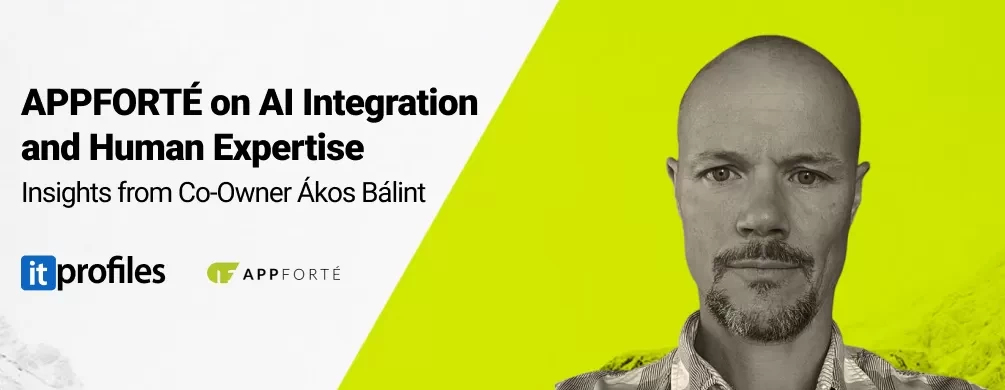
Ákos Bálint, Co-Owner of APPFORTÉ
Founded in 2014, APPFORTÉ began as a specialized provider of staff augmentation services and has since evolved into a full-service software development company serving clients across multiple industries.
“We started the company in 2014, focusing exclusively on staff augmentation,” says Ákos Bálint, Co-Owner. “Since then, we have grown to implement full solutions for clients in various verticals.”
Based in Târgu Mure?, Romania, APPFORTÉ has built a reputation for delivering tailored software solutions while maintaining flexibility and deep client collaboration. Ákos emphasizes that the company’s growth reflects a commitment to adapting to client needs and expanding its expertise beyond personnel support to comprehensive project delivery.
When asked for guidance on adopting AI-driven solutions, Ákos stresses the importance of deep understanding and caution.
“Develop a deep understanding of the type of AI you want to use,” he advises.
“The risks are huge - from compromising your brand to opening backdoors for malicious actors in your or your clients’ infrastructure. AI can do previously unimaginable things, both positively and negatively.”
His advice underscores that while AI offers powerful capabilities, responsible and informed implementation is critical to protect both business and client interests.
According to Ákos Bálint, AI has created a wide spectrum of client expectations, but the overall impact on service demands has been more nuanced than some might assume.
“I think the Gartner cycle perfectly models this hype,” he explains. “People’s expectations vary depending on where they are in this cycle. Some have ‘inflated expectations,’ thinking that AI solves everything overnight, while others are more realistic.”
He adds, “As a matter of fact, I haven’t sensed a significant change in our client’s expectations. Sometimes clients place too much trust in tools like ChatGPT, and it takes time to explain why the outputs can be incorrect.”
Bálint’s view highlights that while AI generates excitement, managing expectations and providing guidance remains a core responsibility for IT service providers.
Share your project details with us for free, and get matched with experienced providers. Use our insights and expert recommendations to confidently choose the right partner for your needs.
At APPFORTÉ, AI has become an integral part of development workflows, spanning everything from small-scale applications to complex backend systems.
“Yes, we are using AI from implementing pet applications and data crunching to writing production code,” explains Ákos Bálint. He highlights a notable example: “We recently rewrote an old PHP backend into both Node.js and Django, using AI to assist in code translation and optimization. This allowed us to compare performance and quality across the three technologies efficiently.”
For APPFORTÉ, AI is not just a tool for automation - it’s a practical resource for experimentation, decision-making, and enhancing development outcomes.
For Ákos Bálint, the most noticeable impact of AI has been in prototyping and writing “single-use” code - scripts or programs designed to automate specific, non-repetitive tasks.
“Before, tasks like data extraction, transformation, and migration required an expert to write code or were done manually,” he explains. “The same goes for testing new ideas - AI now accelerates these processes significantly.”
However, Ákos points out that production code hasn’t seen the same level of improvement. “Features are implemented faster, that’s true, but bug fixing still consumes substantial time. So, in the end, there isn’t a real net gain in efficiency for full-scale production development.”
This perspective highlights that while AI excels in experimental and auxiliary tasks, human oversight remains crucial for robust, production-ready software.
According to him, AI integration at APPFORTÉ is still in its early stages, largely due to concerns around quality, security, and compliance.
“The integration of AI in product development is quite shallow yet,” he admits. “We primarily use it for code generation, but the results are always reviewed and tested by humans.”
This cautious approach ensures that while AI can accelerate certain tasks, human oversight remains essential to maintain security, compliance, and overall product quality.
When asked about the future of AI in software development, Ákos admits the outlook is complex and filled with diverse opinions from industry leaders.
“Difficult to say,” he notes.
“I have met many contradictory opinions from experts like Andrew Ng, Andrej Karpathy, Yann LeCunn, Sam Altman, and others. Some talk about more independent and cooperative AI agents, while others warn of an AI bubble or a potential next AI winter.”
Despite the uncertainty, Ákos believes generative AI will remain mainstream. “The focus will likely shift from pure scaling to increased tool usage,” he says. He adds a cautionary note: “I don’t know if developers will fully address the vulnerabilities of AI agents, but they definitely should.”
This perspective reflects a pragmatic approach - acknowledging both the promise and risks of AI as it becomes more integrated into software development workflows.
For Ákos, preparing the team for AI adoption at APPFORTÉ has been largely organic rather than formal.
“There was no special preparation,” he explains. “People started using LLMs from the release of ChatGPT 3. This is a live topic - we continuously share experiences, best practices, articles, problems, and solutions with each other.”
He adds a pragmatic perspective: “I don’t think AI adoption requires any new skills that a good developer doesn’t already have.” For APPFORTÉ, the focus is on collaborative learning and practical application, allowing the team to integrate AI naturally into their existing workflow.
Ákos emphasizes that despite AI advancements, human developers remain irreplaceable in the software development process.
“In my view, currently generative AI is nothing more than a highly useful and efficient auto-complete,” he explains. “It comes with problems ranging from hallucinations to security leaks, and its knowledge quickly becomes outdated in fast-changing ecosystems like Google Cloud.”
He adds, “Human developers are needed to blueprint and design systems, make critical decisions, supervise AI outputs, and apply common sense wherever it is needed.” This perspective underscores that AI, while powerful, is a tool to augment rather than replace human judgment and expertise.
Post a project for free and quickly meet qualified providers. Use our data and on-demand experts to pick the right one for free. Hire them and take your business to the next level.

ITProfiles is your trusted resource for finding the best IT companies for your development projects.
Built with love by diverse teams based in Denver (CO), Berlin (Germany), India, and Finland.