
Artificial intelligence is transforming how the world creates, consumes, and interacts with digital content. At the forefront of this evolution stands Ayman Abdel-Rahman, CEO of Kotobee, a pioneering platform in interactive ebook creation and digital learning. Since its founding in 2013, Kotobee has grown into a comprehensive ecosystem that empowers authors, educators, and publishers across more than 80 countries to design and deliver immersive digital experiences.
In this exclusive interview with ITProfiles, Ayman discusses how AI is reshaping the software landscape from smarter content creation to more adaptive learning systems. He explores the ways Kotobee is weaving AI into its tools, the challenges of maintaining quality and authenticity, and the new skills developers must embrace to thrive in an AI-first world.


Find My Agency Takes only 2 mins, 100% free
 Table of Content
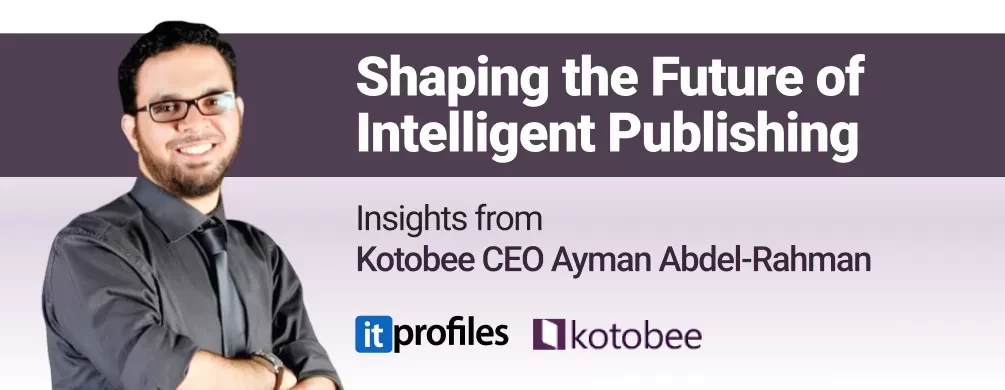
In a conversation with Ayman Abdel-Rahman, he reflects on the company’s inspiring journey from a simple idea to a global platform transforming digital publishing and education.
“I started Kotobee in 2013 with a simple goal to make ebook creation more interactive and accessible for everyone,” Ayman shares. “At that time, most available tools only supported static text, and we saw a clear opportunity to integrate multimedia and interactivity into ebook creation and digital learning.”
The journey began with Kotobee Author, a tool that enables users to create interactive ebooks without any coding knowledge. Over time, Ayman and his team expanded this concept into a complete ecosystem of interconnected platforms, including Kotobee Cloud, Kotobee Library, Kotobee Reader, Kotobee Books, and Kotobee Narrator. Together, these solutions empower authors, educators, and publishers to create, distribute, and even sell ebooks and audiobooks securely.
Today, Kotobee’s footprint extends across more than 80 countries, serving thousands of organizations and independent creators. What started as a modest startup vision has evolved into a global digital learning platform, helping users craft engaging and immersive educational experiences.
As Ayman puts it, the journey has been “an incredible transformation from a single product to an ecosystem that empowers creativity, accessibility, and innovation in interactive publishing.”
Discussing the role of Artificial Intelligence in Kotobee’s evolution, Ayman Abdel-Rahman highlights how the company has strategically adopted AI to make content creation smarter, faster, and more accessible.
“We started integrating AI into our tools after realizing how much it could simplify our users’ workflows, and because the demand for it was undeniable,”
Ayman explains. “Our goal has always been to make technology intuitive, and AI fits naturally into that vision.”
One of the most impactful innovations has been the introduction of AI-powered content creation tools within Kotobee Author. These features allow users to generate text, images, and audio directly inside their ebook projects. Ayman shares a practical example: “A teacher can use the AI tools to instantly generate quiz questions on any topic, then use the AI audio feature to convert text into speech, making their course more inclusive and engaging.”
The impact has been substantial educators and authors now spend less time on manual content creation and more on crafting meaningful learning experiences. AI has not only made Kotobee’s platform more powerful but also more accessible for users with varying technical skills.
Beyond customer-facing tools, Kotobee’s internal teams have also been experimenting with AI to enhance operational efficiency. By automating repetitive tasks and improving user support, the company continues to build a culture where AI is not just a feature, it’s an enabler of productivity, creativity, and smarter problem-solving.
When asked about the areas where Artificial Intelligence has made the most impact, Ayman points out three major domains: content creation, coding, and automation.
“The biggest improvements we’ve seen from AI tools are definitely in those three areas,” Ayman explains. “They’ve helped us work smarter, not harder, and allowed our teams to focus on innovation instead of repetitive work.”
On the content creation side, Kotobee’s marketing and learning teams now leverage AI to generate templates, sample ebooks, and instructional material for users. “These used to take a lot more time and effort,” Ayman adds. “Now, with AI assistance, we can produce educational demos and resources faster and more consistently, which means better onboarding and learning experiences for our customers.”
In the development process, AI has proven invaluable for engineers. “AI tools have made coding easier in many situations,” Ayman says. “They help developers write cleaner code and detect bugs early before they become bigger problems.” This improvement has not only increased development speed but also raised the overall quality and maintainability of Kotobee’s codebase.
Finally, automation stands out as a major transformation area. The Kotobee team now relies on AI for testing, reporting, and analyzing user feedback, streamlining what were once highly manual processes. According to Ayman, this shift “frees up valuable developer time, allowing us to focus on innovation, experimentation, and creating new features that truly matter to our users.”
Share your project details with us for free, and get matched with experienced providers. Use our insights and expert recommendations to confidently choose the right partner for your needs.
When asked what guidance he would offer to businesses considering AI integration, Ayman emphasizes a balanced and realistic approach. Rather than rushing to adopt every new tool, he encourages leaders to think strategically about where AI can deliver measurable, sustainable value.
“My advice would be to start small and stay realistic about what AI can do for your business,” says Ayman.
“It’s easy to get caught up in the hype, but AI is not a magic solution. It works best when you use it to enhance your existing processes, not replace them completely.”
He suggests focusing on one or two high-impact areas, those that can quickly show tangible benefits. “Focus on one or two areas where AI can make a real difference, such as automating repetitive work or improving content creation. Once you see the results and understand its limits, you can expand from there.”
Ayman also stresses a critical reminder that resonates across industries: AI should amplify human capabilities, not eliminate them. “Always keep the human element in the loop,” he says. “AI is powerful, but it still needs human judgment, creativity, and context to deliver real value.”
For Kotobee, this philosophy has guided their approach, leveraging AI to empower creators and educators, while ensuring that the human touch remains at the heart of innovation.
Looking ahead, Ayman Abdel believes the next few years will redefine how developers and businesses interact with technology. “I think the next few years will be all about smarter automation and personalization,” he says. “AI tools will not just help developers write code faster, they will also understand entire projects and suggest improvements based on context.”
This evolution, he explains, will make software development a true collaboration between human creativity and AI precision. Developers will focus more on innovation and problem-solving, while AI systems will handle repetitive or complex logic-based tasks.
One of the biggest shifts Ayman anticipates is the rise of natural language interfaces. “Instead of writing long technical scripts, developers and even non-technical users will be able to describe what they need in plain language, and AI will generate the logic or workflow behind it.” This could significantly lower the barrier to entry for digital creation and open software development to a broader audience.
He also points to AI-driven quality assurance and testing as a key area of transformation. Tools will soon be able to simulate real-world user behavior, catch usability issues early, and even predict performance challenges before deployment, helping teams deliver more reliable products.
However, Ayman emphasizes that as AI’s role deepens, ethics and transparency will become non-negotiable. “As we rely on AI more, businesses will need to be clear about how data is used and make sure the systems they build are fair, secure, and explainable.”
For Ayman, the next era of development will not just be about faster delivery; it will be about building trustworthy, intelligent, and human-centered technology.
For Ayman, adapting to the rapid changes AI brings is not just about technical upgrades; it is about cultivating the right mindset. “Our focus has been on helping everyone understand how to use it effectively, not just technically,” he shares. “We encourage our team to treat AI as a partner that can boost productivity and creativity, rather than something that replaces their skills.”
To prepare his workforce for this transformation, Ayman explains that Kotobee is balancing technical fluency with human creativity. On the technical front, developers are encouraged to explore AI tools, prompt engineering, and automation frameworks, learning how to integrate these capabilities into everyday workflows. But equal weight is placed on soft skills like critical thinking and content evaluation. “Knowing how to question and refine AI output is just as important as knowing how to generate it,” he notes.
Kotobee also runs internal workshops and collaborative sessions where team members share how they are using AI in real projects. This open exchange, Ayman says, keeps curiosity alive and drives organic learning across teams.
Ultimately, the company’s vision is to make AI a natural part of its culture, a seamless extension of human intelligence rather than a replacement for it. “The goal,” Ayman concludes, “is to make AI work with us, not instead of us. Human insight will always stay at the center of everything we do.”
Easily connect with top-qualified providers for your project. Post your requirements for free, and let our data-backed insights and experts match you with the best service providers.
When asked about the future of human developers in an AI-first era, Ayman Abdel-Rahman speaks with confidence about their enduring importance. “Human developers will always have a central role, even in an AI-first world,” he affirms. “AI can generate code, suggest optimizations, and handle repetitive work, but it does not understand context, emotion, or the purpose behind a product.”
He explains that the role of developers is evolving from execution to strategic orchestration. Rather than focusing on writing every line of code, developers of the future will serve as architects and problem solvers, defining how intelligent systems function, learn, and interact with users. Their work will involve guiding AI tools and making high-level decisions about design, ethics, and user experience.
According to Ayman, this transformation elevates developers into the realm of creative technologists, bridging logic with empathy.
“In the end, I believe that it is human vision and empathy that turn technology into something meaningful and impactful,” he says.
In a world increasingly influenced by automation, Kotobee’s philosophy remains clear: technology should enhance human potential, not replace it.
Artificial intelligence has completely transformed what clients expect from technology providers.
“I believe that AI has definitely raised the bar for what clients expect from technology providers,” he says. “Clients today are not just looking for software that performs a task; they want technology that understands their goals and helps them work smarter.”
This shift, Ayman explains, is changing the entire relationship between IT service providers and their clients. The focus is no longer on simply developing functional systems but on building intelligent platforms that adapt, learn, and deliver immediate value. He gives a clear example from the publishing sector: “In the past, a publisher might have asked us to build an ebook platform that supports multimedia content. Now, they would want us to provide a platform that can automatically generate content, create quizzes, and even offer text-to-speech functionality.”
These evolving expectations highlight how AI is driving a demand for smarter, more proactive technology tools that don’t just execute commands but contribute to the user’s goals. Ayman believes this is pushing IT companies to rethink their approach: “It is no longer just about building systems that function well. It is about building intelligent systems that learn, automate, and provide real value for users right away.”
For modern service providers, this means the new standard of success is not just performance, but how intelligently technology collaborates with human intent.
Post a project for free and quickly meet qualified providers. Use our data and on-demand experts to pick the right one for free. Hire them and take your business to the next level.

ITProfiles is your trusted resource for finding the best IT companies for your development projects.
Built with love by diverse teams based in Denver (CO), Berlin (Germany), India, and Finland.