In a rapidly evolving digital landscape, Aseto, a forward-thinking software development company, stands at the forefront of AI-driven transformation. Under the leadership of its CPO, Antonis Koumantaris, of Aseto, based in Cyprus, the company has been pioneering in-house AI voice and text systems that demonstrate how intelligent automation can reshape industries from hospitality to enterprise software.
In this Exclusive conversation with IT Profiles, Koumantaris discusses how artificial intelligence is redefining client expectations in the IT service industry, the challenges of real-world AI adoption, and the evolving role of human developers in an AI-first era. The following insights capture their journey from integrating AI into development pipelines to preparing teams for the future of intelligent software creation.


Find My Agency Takes only 2 mins, 100% free
 Table of Content
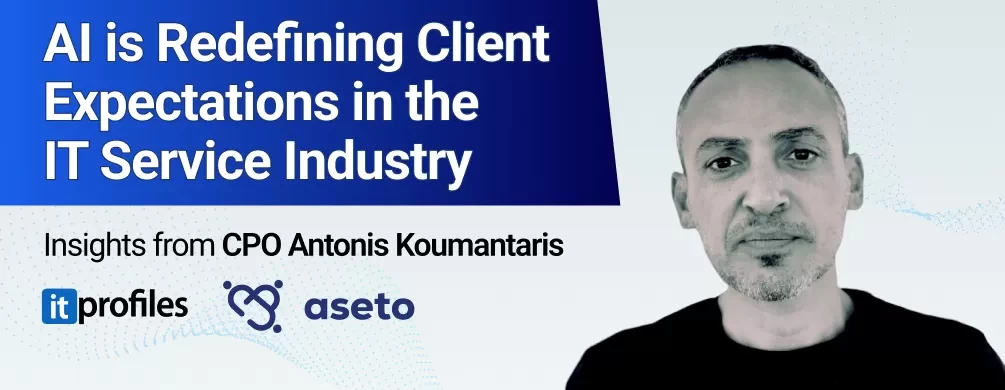
When asked about the origins and evolution of Aseto, CPO Antonis Koumantaris spoke with conviction about the company’s purpose and vision. “Aseto was founded in 2024 in Larnaca, Cyprus, with a bold mission: to transform how businesses communicate through AI-powered voice and omnichannel automation,” he began.
From the start, Aseto distinguished itself by developing a fully in-house AI pipeline for both voice and text, avoiding third-party API dependencies. This independence, Koumantaris explained, gives the company full control over quality, pricing, and crucially data privacy.
Following a year of intensive research and development, Aseto has grown into a cutting-edge AI company delivering real-world solutions for forward-thinking organizations across sectors such as hospitality, logistics, finance, and the public sector.
Today, Aseto’s intelligent voice and text agents enable seamless communication across every customer touchpoint, whether through phone, web, WhatsApp, Instagram, or Messenger. The company trains and fine-tunes its own Speech-to-Text (STT) and Text-to-Speech (TTS) models, including one for the Cypriot Greek dialect, ensuring conversations sound natural, context-aware, and authentically human.
As Aseto enters the global market, its mission extends beyond external communication. The company is integrating AI into internal business processes to enhance efficiency and productivity while also investing in education and awareness. Through professional seminars and AI literacy initiatives in Cyprus and Greece, Aseto empowers teams to understand, adopt, and lead confidently in the AI era.
When discussing how Aseto began integrating AI into its development projects, Koumantaris highlighted the company’s commitment to independence and innovation. “We began integrating AI into our development projects by building our own end-to-end AI voice and text pipeline,” he explained. “This approach enables us to deploy intelligent automation without relying on third-party APIs.”
This foundation allows Aseto to maintain full control over data, performance, and scalability factors that are often limited when using external AI services. Koumantaris shared a tangible example that demonstrates Aseto’s impact: the development of an AI Voice Agent tailored for the hospitality sector.
“This solution manages real-time guest inquiries, reservations, and follow-ups across both phone and messaging channels,” he said. The system not only enhances guest engagement but also significantly reduces operational costs by automating repetitive communication tasks.
The project, he noted, reflects Aseto’s broader mission: to bring AI from theoretical potential into everyday business practice.
“It’s a clear demonstration of how our in-house technology improves customer experience and shows the practical power of AI-driven communication in real business environments.”
When asked which areas of Aseto’s development process have benefited most from AI, Antonis pointed to the company’s technical backbone and its AI-driven workflow. “The biggest improvements come from using AI to accelerate testing, optimization, and voice model training,” he explained.
Through the integration of AI into its development pipeline, Aseto has automated a wide range of tasks that once required extensive manual effort.
“We’ve automated processes like speech data labeling, voice synthesis tuning, and natural language model refinement,” Koumantaris said.
These optimizations have transformed development timelines, cutting what previously took weeks down to mere hours. The result is a faster, more agile production cycle that allows Aseto’s engineers to focus on higher-level innovation and fine-tuning user experience, rather than getting bogged down in repetitive data and testing tasks.
This leap in efficiency underscores the company’s philosophy: that AI is not just a feature in their products, but a force that drives continuous improvement across every layer of their operation.
Share your project details with us for free, and get matched with experienced providers. Use our insights and expert recommendations to confidently choose the right partner for your needs.
Reflecting on Aseto’s journey with AI, Koumantaris shared a candid view of the complexities behind creating production-grade artificial intelligence. “One of the biggest lessons we’ve learned is that building AI in practice is very different from what you read in theory,” he said.
According to Koumantaris, the challenges in real-world AI projects extend well beyond achieving strong model accuracy. “In real-world development, challenges go far beyond model accuracy,” he explained. “They involve data quality, ethical responsibility, and security compliance at every step.”
For Aseto, this has meant building a culture of diligence where every dataset is vetted, every model’s output is evaluated for bias, and every system is designed with strict privacy standards in mind. These principles are especially critical given the company’s focus on voice and omnichannel automation, where sensitive customer data often flows through multiple communication layers.
Koumantaris emphasized that these challenges, while demanding, are also what make Aseto’s solutions robust and trustworthy. “AI development is not just about innovation,” he concluded. “It’s about accountability, ensuring that what we build truly benefits people, businesses, and society as a whole.”
When asked what advice he would give to businesses exploring AI-driven solutions, Koumantaris emphasized the importance of integrity and realism in a rapidly evolving market. “If I could give one piece of advice to businesses considering AI-driven solutions, it would be this: find a partner who will tell you the truth every step of the way,” he said.
Koumantaris cautioned against the common misconception that AI is a quick-fix solution. “AI isn’t magic,” he explained. “It’s powerful, but it requires clarity, patience, and honest guidance to unlock real value.” Many providers, he noted, tend to overpromise immediate results without understanding a company’s underlying data or operational needs.
For Aseto, responsible implementation is about more than just technology; it’s about partnership and trust. “True transformation comes from understanding your data, your processes, and your goals,” Koumantaris added. “Choose a partner who’s transparent about what AI can and can’t do, who builds responsibly, and who aligns technology with your business reality, not just the hype. That’s how you build solutions that last.”
In his view, success in AI adoption is not defined by speed but by sustainability, by creating systems that are ethical, scalable, and grounded in real business outcomes.
Looking toward the future, Koumantaris offered a clear and confident outlook on where AI is heading. “We’ll see rapid growth in autonomous agents capable of executing complex tasks end-to-end,” he predicted. These intelligent systems will handle multi-step workflows independently, marking a major leap from today’s task-specific automation.
Koumantaris also highlighted the rise of multimodal AI models that can seamlessly process and understand voice, text, and visual data together. “This will create a more natural and integrated way for humans and machines to interact,” he said, noting that such advances will redefine how applications perceive and respond to the world around them.
On the infrastructure side, edge AI is set to bring intelligence closer to users, enabling real-time decision-making without the delays of cloud dependency. “It’s about speed, privacy, and autonomy,” Koumantaris explained.
For developers, AI copilots will soon become an everyday tool, accelerating coding, testing, and deployment cycles. Meanwhile, at the enterprise level, the focus will shift toward domain-specific and privately trained models, custom AI systems designed to reflect a company’s own data, language, and workflow.
Together, these trends point to a future where AI is not just a support tool but a central force in how software is conceived, built, and delivered.
When asked how Aseto is preparing its workforce for the AI revolution, Koumantaris emphasized the company’s deep commitment to learning and adaptability. “We’re preparing our team for the AI shift by investing heavily in continuous learning and hands-on experimentation,” he said.
At Aseto, this preparation goes beyond technical upskilling. “Everyone at Aseto, from developers to project managers, is encouraged to understand not just how AI works, but how it creates business value,” Koumantaris explained. This holistic approach ensures that AI is not viewed as a standalone technology but as a core part of how the company delivers innovation and efficiency for its clients.
Through workshops, internal training programs, and real-world experimentation, Aseto’s teams are developing both technical fluency and strategic insight skills that enable them to integrate AI meaningfully into projects and processes. The goal, according to Koumantaris, is to build a culture where curiosity and practical problem-solving drive progress.
“It’s not just about learning to use AI tools,” he noted. “It’s about learning to think with AI to see how it can transform the way we work, communicate, and deliver results.”
In discussing the future of the software development industry, Koumantaris offered a balanced and insightful perspective on the evolving relationship between humans and machines. “Human developers will remain essential in an AI-first world; in fact, their role will become even more critical,” he asserted.
While AI systems can generate, optimize, and automate, Koumantaris noted that they still lack the deeper layers of understanding that humans inherently possess. “AI can’t guide itself,” he explained. “It lacks context, intention, and ethical judgment, all things that only humans bring.”
In this new era, developers will evolve into architects, mentors, and quality guardians of AI systems. Their responsibilities will extend beyond coding to setting direction, ensuring security, and aligning AI behavior with strategic and ethical goals.
“Developers will be the ones translating business objectives into intelligent, responsible behavior,” Koumantaris said. “AI can execute brilliantly, but humans will continue to define what should be built, why it matters, and how it should serve people.”
This partnership between human insight and machine intelligence, he believes, will define the next generation of software innovation where creativity, responsibility, and technology coexist seamlessly.
AI is redefining the entire relationship between clients and IT service providers. A few years ago, businesses primarily sought providers who could deliver reliable, functional software. Today, that baseline has shifted; clients expect intelligent systems that can adapt, predict, and optimize outcomes in real time. They are looking for solutions that not only automate processes but also generate insights and drive decision-making.
This shift has made innovation and business understanding just as important as technical skills. Clients now want partners who can translate complex AI capabilities into real business impact, from improving customer engagement and operational efficiency to creating new revenue opportunities. They expect IT teams to be proactive, data-driven, and capable of integrating AI seamlessly into existing systems without disrupting workflows.
In short, AI has raised the bar. It’s no longer enough to build technology that works; it has to think, learn, and continuously add value. The most trusted IT providers today are those who can combine deep technical expertise with strategic foresight, helping businesses evolve faster in a world where intelligence is becoming the new infrastructure.
Easily connect with top-qualified providers for your project. Post your requirements for free, and let our data-backed insights and experts match you with the best service providers.
Post a project for free and quickly meet qualified providers. Use our data and on-demand experts to pick the right one for free. Hire them and take your business to the next level.

ITProfiles is your trusted resource for finding the best IT companies for your development projects.
Built with love by diverse teams based in Denver (CO), Berlin (Germany), India, and Finland.