
As AI continues to transform the software development landscape, companies are redefining how they deliver value to clients. SunTec India, a global digital engineering and technology partner, has embraced AI not just as a tool but as a core enabler of innovation.
In this interview with ITProfiles, Rohit Bhateja, Director of Digital Engineering Services and Head of Marketing, shares how SunTec India integrates AI across development processes, prepares its teams for an AI-first world, and meets evolving client expectations with intelligent, scalable solutions.


Find My Agency Takes only 2 mins, 100% free
 Table of Content
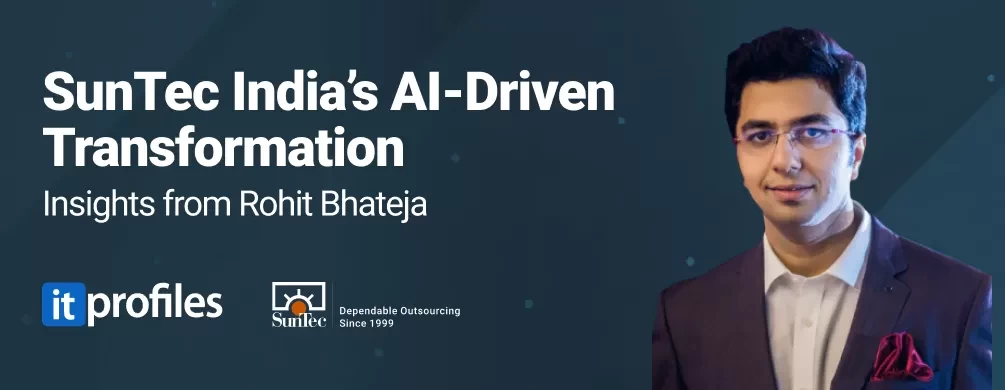
Rohit Bhateja, Director of Digital Engineering Services and Head of Marketing - SunTec
For over two decades, SunTec India has been quietly shaping the global outsourcing landscape. What began as a data and IT services company has grown into a full-scale digital engineering and technology partner for businesses across the world.
“We started over 25 years ago with a simple goal - to help global enterprises manage and scale their operations efficiently through data and technology,” says Rohit Bhateja, Director of Digital Engineering Services and Head of Marketing at SunTec India. “Since then, the pace of digital transformation has changed everything, and so have we.”
Founded in 1999, SunTec India’s evolution reflects its long-term vision to move beyond back-office outsourcing and become a strategic technology enabler. Today, the company delivers a wide range of solutions, from application development, UI/UX engineering, and DevOps to cloud modernization and AI/ML-driven innovation.
“Our focus has always been on creating scalable, secure, and intelligent digital ecosystems,” Rohit explains. “We want to help clients accelerate time-to-market, drive customer engagement, and make technology a true business advantage.”
With clients spanning multiple continents and industries, SunTec India now stands as a trusted global partner known for its domain expertise, engineering excellence, and ability to adapt to the changing needs of a digital-first world.
For Rohit Bhateja and his team at SunTec India, artificial intelligence isn’t just an add-on - it’s become an integral part of how they design, build, and deliver software solutions.
“We’ve started using AI to improve efficiency in development projects,” Rohit explains. “Our teams leverage AI-driven tools for automated testing and code reviews, helping us deliver faster and with better accuracy.”
But the impact goes far deeper than speed and precision. “AI is now deeply integrated into our entire development and delivery lifecycle,” he adds. “We use it not just as an enhancement layer but as a core enabler of intelligent automation and predictive insights.”
He recalls a recent eCommerce modernization project where SunTec India embedded AI-powered recommendation engines and natural language search to create personalized user journeys. “On the engineering side, our developers use AI-assisted code generation and testing tools to increase velocity and minimize defects,” Rohit says. “These integrations have shortened release cycles, improved customer engagement, and reduced maintenance overheads.”
For SunTec India, AI has become both a productivity multiplier and a business differentiator, driving efficiency while elevating the quality and intelligence of every solution they deliver.
According to Rohit Bhateja, some of the most dramatic gains from AI have come in the areas of testing, quality assurance, and project management. “AI helps us save time, reduce errors, and deliver projects more efficiently,” he shares.
At SunTec India, AI now drives significant optimization across multiple stages of the development pipeline. “We’ve seen measurable improvements in code quality assurance, testing, and DevOps automation,” Rohit explains. “AI-powered tools for intelligent test case generation, automated bug detection, and code reviews have reduced manual validation efforts by more than 40%.”
In the DevOps space, AI-driven monitoring and anomaly detection help teams predict system issues before they affect production environments. Rohit adds, “We’re also using AI-assisted UX design tools to enable data-driven personalization and speed up prototyping.”
These advancements have led to higher development throughput, lower technical debt, and improved reliability across projects. “The beauty of AI,” Rohit notes, “is that it allows our teams to spend less time on repetitive tasks and more time on real innovation.”
According to Rohit Bhateja, AI is redefining what clients expect from their IT partners. “Clients now want more than just software development,” he explains. “They’re looking for intelligence baked into solutions faster delivery, automation, personalized experiences, and actionable insights that give them a competitive edge.”
The conversation with clients has shifted from “build this application” to “how can AI help us scale intelligently?” Rohit notes that enterprises increasingly demand that partners embed intelligence across the entire value chain - from product design and user analytics to cloud operations and cybersecurity.
Moreover, clients expect explainable AI models, ethical governance, and accelerated innovation cycles. “The benchmark has moved from traditional service delivery to AI-driven digital acceleration,” he emphasizes, highlighting how AI adoption is reshaping both expectations and partnerships in the IT services industry.
Share your project details with us for free, and get matched with experienced providers. Use our insights and expert recommendations to confidently choose the right partner for your needs.
Adopting AI at scale has been as much about responsibility as it has been about innovation, says Rohit Bhateja. “The main challenges have been around data security, compliance, and making sure AI outcomes are accurate and unbiased,” he explains. “We focus on responsible adoption to address these areas.”
According to Rohit, AI implementation comes with its own set of nuanced hurdles.
“The biggest issues we’ve faced are data quality, model transparency, and compliance alignment. Enterprise datasets often require extensive cleansing and labeling before training even begins.”
Ensuring ethical AI practices has become a top priority for SunTec India. “We’re constantly working to avoid bias, preserve privacy, and maintain explainability,” Rohit emphasizes. “That means having strong governance frameworks in place.”
Security has also emerged as a key consideration. “When integrating AI into cloud-native environments, protecting models and controlling access are critical,” he says. To manage this, the company has implemented MLOps pipelines with built-in compliance checks, versioned datasets, and detailed audit trails - a system designed to ensure transparency and accountability throughout the AI lifecycle.
When asked what advice they’d give to organizations embarking on their AI journey, they emphasized one central idea - treat AI as a long-term strategic enabler, not a quick technological fix.
“Start with alignment, not experimentation,” he explained. “AI adoption should always tie back to measurable business objectives - whether it’s enhancing customer experience, streamlining workflows, or driving smarter decisions.”
Too often, enterprises rush into pilot projects without a solid foundation. “Data readiness and governance are where most organizations stumble,” added Rohit. “Invest in data quality, ensure model transparency, and plan for scalable integration from the start.”
According to him at SunTec, successful AI transformation is as much about people and processes as it is about technology. “Think of it as a cultural shift - a journey that blends innovation with accountability.”
When discussing the future of AI in software development, Rohit Bhateja painted a picture of a fast-evolving landscape where intelligent systems will not only assist developers but also begin to act autonomously within the development lifecycle.
He believes the next three to five years will see Agentic AI take center stage - systems capable of reasoning, planning, and executing tasks independently. “These won’t just assist with code completion,” Rohit explained, “they’ll manage workflows, run tests, detect anomalies, and even optimize deployments in real time.”
Generative AI, he noted, will continue to mature into a foundational tool for developers, accelerating everything from code generation and UX prototyping to documentation and QA automation. Meanwhile, multimodal LLMs will enable seamless integration of text, visuals, and voice within the same development framework, opening new creative possibilities for human-AI collaboration.
On the operational side, Rohit sees AI-powered observability, predictive DevOps, and intelligent cybersecurity as critical pillars of the next-generation software ecosystem. “AI will make systems self-healing, self-secure, and self-optimizing,” he said. “That’s where we’re headed - towards an era of autonomous, intelligent software delivery.”
As cloud-native and edge computing continue to converge, Rohit believes this shift will “accelerate distributed intelligence,” enabling smarter, faster, and more resilient enterprise systems that evolve continuously - with AI at their core.
When asked how SunTec India (suntecindia.com) is preparing its workforce for the rapid transformation AI is driving, Rohit Bhateja was clear that success in this new era will depend as much on mindset as on technical capability.
“We’re investing heavily in AI literacy and hands-on learning,” he said. The company has rolled out structured upskilling programs that cover everything from data engineering and model deployment to prompt engineering and MLOps. Engineers and analysts alike are being trained on tools such as TensorFlow, PyTorch, and leading GenAI platforms, ensuring they can work fluidly across the evolving AI stack.
But Rohit emphasized that this shift isn’t purely about technology. “We’re equally focused on cultivating adaptability, critical thinking, and responsible AI use,” he explained. Teams are encouraged to collaborate across functions, bringing together developers, data scientists, and domain experts, to solve problems holistically rather than in silos.
Ethical design and AI governance frameworks are also key priorities. “Our people need to understand not only how AI works but also how to deploy it responsibly,” Rohit noted. By instilling this balance between innovation and accountability, SunTec India aims to build a workforce that’s ready to engineer AI-driven products with both technical precision and human responsibility.
As AI becomes deeply woven into software development, Rohit Bhateja believes that human developers will not disappear - they’ll simply evolve.
“Developers will move from being coding executors to becoming strategic orchestrators and AI supervisors,” he said. While AI takes over repetitive tasks like testing, debugging, and documentation, human engineers will focus on higher-value areas - architecture, innovation, ethical decision-making, and product experience.
According to Rohit, creativity and contextual judgment will remain irreplaceable. “AI can predict, optimize, and automate, but it can’t truly imagine or empathize,” he explained. That’s where human developers make the difference - guiding AI systems to align with real-world needs and business goals.
He summed it up with a forward-looking perspective: “In an AI-first world, the best outcomes will come from synergy - where human ingenuity and machine intelligence work together, not compete.”
Post a project for free and quickly meet qualified providers. Use our data and on-demand experts to pick the right one for free. Hire them and take your business to the next level.

ITProfiles is your trusted resource for finding the best IT companies for your development projects.
Built with love by diverse teams based in Denver (CO), Berlin (Germany), India, and Finland.