
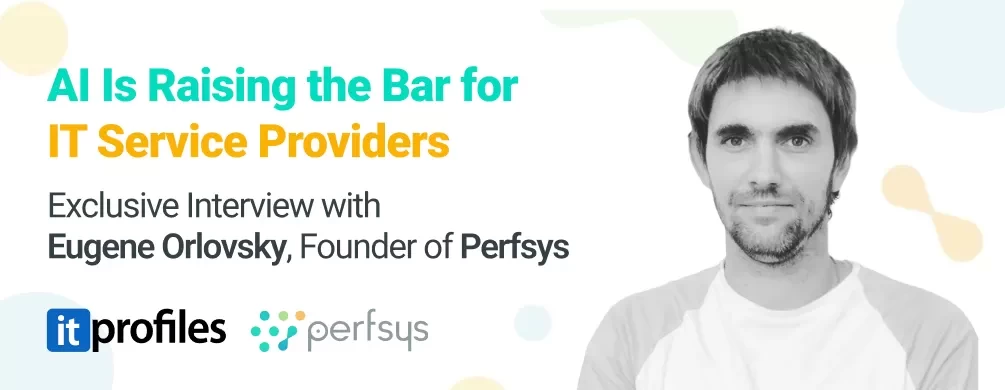
In an exclusive conversation with ITProfiles, Eugene Orlovsky, Founder of Perfsys, discusses how artificial intelligence is reshaping what clients expect from IT service providers today. With more clients experimenting with tools like ChatGPT and Claude before engaging professionals, the dynamic has shifted; clients are more informed, more confident, and often come with preconceived ideas of how AI can simplify development.
Orlovsky explains that while this awareness is a positive step, it also brings new challenges. Many underestimate the complexities of real-world implementation, assuming AI can instantly replace deep technical expertise. In the interview, he reflects on how Perfsys balances these expectations by integrating AI responsibly into development and testing while maintaining human oversight and precision.
This ITProfiles exclusive sheds light on a critical truth: in the AI era, success depends not on replacing developers, but on empowering them to deliver smarter, faster, and more transparent solutions.


Find My Agency Takes only 2 mins, 100% free
 Table of Content
When Eugene Orlovsky founded Perfsys in 2013, his goal was simple yet ambitious: to help businesses use the cloud not just as infrastructure but as a driver of innovation. Over the years, that vision has taken shape through a focused commitment to Amazon Web Services (AWS). What began as a small team passionate about cloud technologies has grown into a trusted DevOps and engineering company known for its precision, reliability, and deep technical understanding.
Today, Perfsys provides a full range of services, including DevOps consulting, managed services, cloud architecture, and AWS audits. The company specializes in helping small and medium-sized businesses improve, scale, and modernize their digital systems with intelligent automation and cloud-native design.
For Eugene and his team, the mission goes beyond technology. It is about building systems that make growth sustainable and innovation attainable for every client. Each project reflects Perfsys’s belief that the right cloud strategy can simplify complexity, reduce costs, and open new possibilities.
From startups seeking efficiency to established firms pursuing modernization, Perfsys continues to bridge the gap between ambition and execution, one AWS solution at a time.
When asked about Perfsys’s first steps into AI integration, Eugene Orlovsky explained that the company approached it from a deeply practical standpoint. Rather than chasing trends, they focused on tools that could enhance their existing AWS-driven workflows.
“One of the most promising directions for us,” Eugene shared, “has been integrating Claude Code with AWS Bedrock. This combination allows us to develop efficiently while using AWS credits instead of paying third-party providers directly.”
For a company so rooted in the AWS ecosystem, this approach made perfect sense. By linking Claude Code directly with Bedrock, Perfsys gains both flexibility and cost efficiency, ensuring development remains fast, secure, and tightly connected to the infrastructure clients already rely on.
The setup has proven particularly beneficial for startups and mid-sized businesses, where budgets are tight and every minute of development time matters. It is a clear example of how Perfsys blends AI innovation with operational practicality, choosing integrations that strengthen their ecosystem rather than complicate it.
When it comes to measurable impact, Eugene Orlovsky points to two areas where AI has made the biggest difference at Perfsys: development and testing.
“AI helps us accelerate code creation based on requirements,” he explained. “It’s incredibly effective for automatically generating test cases, from unit tests to integration and UI tests. It saves a lot of time and allows our engineers to focus on more creative and complex parts of the work.”
For a team known for precision and reliability, this shift has been transformative. By automating repetitive testing processes and assisting in code generation, Perfsys has been able to shorten delivery cycles without compromising on quality. The company’s engineers now dedicate more energy to architectural planning, optimization, and innovation, leading to smarter, more resilient systems.
In essence, AI has not replaced their expertise; it has amplified it, turning efficiency into a foundation for even deeper engineering excellence.
Share your project details with us for free, and get matched with experienced providers. Use our insights and expert recommendations to confidently choose the right partner for your needs.
While many companies cite ethical or compliance concerns when adopting AI, Eugene Orlovsky points out that Perfsys’s biggest challenge has been technical compatibility.
“Our main challenge has been technical, not ethical,” he explained. “For example, Claude Code integrates smoothly with AWS Bedrock, but Cursor IDE, even though it’s a great product, doesn’t yet work well with Bedrock. For us, that’s a problem, because we rely heavily on AWS infrastructure and credits.”
As a company deeply committed to the AWS ecosystem, Perfsys prioritizes tools that fit seamlessly within that environment. However, the fast-evolving nature of AI platforms often creates integration gaps, where even advanced tools may not yet align with specific technical or billing frameworks.
Rather than forcing mismatched solutions, the team focuses on maintaining ecosystem consistency, ensuring every AI tool they adopt complements their existing architecture. This approach underscores Perfsys’s belief that true innovation happens when technology integration is not just possible, but also practical and sustainable.
When asked what advice he would give to businesses still debating whether to adopt AI, Eugene Orlovsky didn’t hesitate.
“If you’re still considering AI, you’re already behind,” he said.
For him, the conversation has moved past if and firmly into how. “You shouldn’t be thinking whether to use AI; you should already be using it. The market is moving fast, and hesitation means you’re falling behind competitors who are already experimenting, implementing, and learning.”
Eugene’s message is clear: adoption is the only way forward. The companies gaining the most from AI are not necessarily those with the biggest budgets or teams, but those willing to act quickly, learn continuously, and integrate intelligently.
“So my advice is simple,” he added. “Act now, learn fast, and integrate AI into your workflow today.”
It’s a mindset that reflects the core of Perfsys’s philosophy: progress belongs to those who are bold enough to start.
According to Orlovsky, the next few years will usher in a new era of text-based development, where engineers describe what they want in natural language and AI generates the corresponding code. He emphasizes that this evolution is already underway, but it brings both opportunity and risk.
While AI-driven automation promises efficiency and accessibility, Orlovsky warns that overreliance on these tools may erode developers’ foundational understanding of systems, logic, and mathematics.
“AI is a powerful ally, not a silver bullet,” he explains. “It should amplify human intelligence, not replace it.”
He also predicts a major shift in developer roles, especially at the entry level, as AI begins to handle many of the repetitive tasks once reserved for junior engineers. To remain relevant, professionals will need to upskill faster, focusing on problem-solving, architecture, and strategic thinking, areas where human creativity and reasoning still outpace machines.
In Orlovsky’s view, the future of development will be defined not by AI replacing humans, but by humans learning to collaborate intelligently with AI.
Easily connect with top-qualified providers for your project. Post your requirements for free, and let our data-backed insights and experts match you with the best service providers.
During his interview, Eugene Orlovsky outlined his unconventional but effective approach to integrating AI into company workflows. Rather than enforcing a one-size-fits-all adoption model, Orlovsky believes in giving team members the freedom to choose the AI tools that best complement their roles and working styles.
“At Perfsys, AI isn’t a separate department or project,” he explains.
“It’s part of every process, from development and customer management to sales and lead generation. But how people use it depends on what works best for them.”
This flexible, people-centric philosophy ensures that innovation is both scalable and sustainable, allowing individuals to engage with AI at their own comfort level while still aligning with company objectives.
Orlovsky emphasizes that AI adoption should enhance, not disrupt, daily operations. His approach promotes a culture of experimentation and continuous learning, where employees are encouraged to explore new tools, challenge old methods, and use AI as a partner rather than a replacement.
By embedding AI seamlessly across functions and empowering teams to adapt it independently, Perfsys exemplifies how organizations can build smarter, more adaptable workforces ready for the next wave of digital transformation.
The idea of an entirely “AI-first” world sounds compelling, but in reality, it is far from practical. As Eugene Orlovsky points out, there will always be a human in the loop; the question is, which humans will remain essential?
The rise of AI is transforming how software is built, and while repetitive coding tasks may become automated, the demand for strategic thinkers, architects, and problem-solvers will only increase. Developers who understand systems holistically, not just how to code, but why things work the way they do, will define the future of technology.
To stay relevant, engineers must go beyond syntax and frameworks. They need to master fundamentals like mathematics, logic, and systems thinking, skills that AI cannot easily replicate. However, the challenge lies in how the next generation of developers will gain practical experience when entry-level coding is increasingly handled by AI.
As Orlovsky emphasizes, the future belongs to those who can blend human insight with AI capability, shaping technology, not just using it.
AI has undeniably reshaped how clients interact with IT service providers, not by changing what they expect, but by deepening their understanding. As Eugene Orlovsky explains, the core expectations remain the same: quality solutions, professional communication, predictable budgets, and timely delivery.
What’s new is the level of client preparedness. Many clients now experiment with tools like ChatGPT or other large language models before reaching out. They arrive with a clearer sense of what’s possible, sometimes even with snippets of AI-generated code. This makes discussions more productive since both sides share a stronger technical vocabulary.
However, there’s a flip side. AI tools can create an illusion of simplicity, leading some clients to underestimate the complexity of real-world development. Generating code is one thing; building secure, scalable, and maintainable systems is another.
As Orlovsky notes, AI has elevated the conversation; clients are more informed and engaged, but it has also raised the bar for transparency, education, and trust in every project discussion.
Post a project for free and quickly meet qualified providers. Use our data and on-demand experts to pick the right one for free. Hire them and take your business to the next level.

ITProfiles is your trusted resource for finding the best IT companies for your development projects.
Built with love by diverse teams based in Denver (CO), Berlin (Germany), India, and Finland.