
As AI continues to redefine the software landscape, IT service providers are rethinking how they design, build, and deliver solutions. Raul Rusu, CEO of Flowmatters, shares how his company has embraced AI to enhance efficiency, improve decision-making, and deliver measurable business value to clients across Europe and the US.
In this interview, Rusu reflects on Flowmatters’ journey from a small software studio in Cluj-Napoca to a 40+ person team tackling complex CRM and back-office projects. He highlights how AI is integrated into development workflows, the lessons learned in adopting these technologies, and the ways client expectations are evolving in an AI-first world.
Through his insights, we gain a clear view of how AI isn’t replacing developers - it’s amplifying human expertise, accelerating processes, and transforming client relationships in the software industry.


Find My Agency Takes only 2 mins, 100% free
 Table of Content
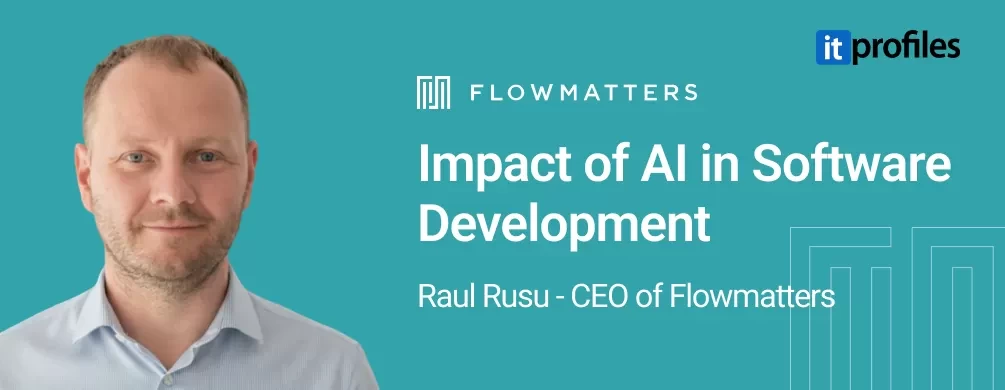
Raul Rusu - CEO of Flowmatters
“We started Flowmatters back in 2013 in Cluj-Napoca, Romania,” says Raul Rusu, CEO of Flowmatters (flowmatters.com). “From the beginning, our mission was clear: build custom software that actually solves operational problems for businesses. Very early on, we realized that companies were constantly struggling with fragmented processes and disconnected data, so we decided to focus on CRM platforms and back-office systems.”
Over the years, the company has grown into a team of more than 40 specialists, working with clients across Europe and the US. “Most of our projects today involve designing and delivering systems that improve efficiency and decision-making. In many cases, we’re helping businesses replace outdated legacy tools with modern, integrated solutions,” Rusu explains.
When asked about where Flowmatters stands today, he sums it up succinctly: “We’re in a sweet spot. Big enough to take on complex, long-term projects for established clients, yet still small and agile enough to adapt quickly and work closely with stakeholders. It’s the balance that allows us to deliver real impact.”
Flowmatters began exploring AI tools in 2020, starting with small experiments to improve efficiency in routine development tasks such as code review and documentation. Over time, these experiments evolved into a more structured approach, integrating AI into projects where it could create tangible value for clients.
“One area where we’ve seen real impact is in CRM and back-office automation,” says Raul Rusu, CEO of Flowmatters. He recalls a recent project for a services company where AI models were used to classify customer requests and route them to the appropriate team. “Tasks that once took hours of manual effort are now completed in seconds. The client reported faster response times and higher customer satisfaction,” he notes.
By embedding AI strategically, Flowmatters is not just automating repetitive work. The team can now focus on more complex problem-solving and high-value work, improving both productivity and the overall quality of the solutions they deliver. As Rusu puts it, “Our approach is to use AI where it creates measurable value, helping people focus on the parts of their job that really matter.”
At Flowmatters, the introduction of AI has transformed some of the most repetitive and time-consuming parts of the development process. Routine tasks like code review, automated testing, and documentation, which once consumed significant developer time, are now faster, more accurate, and consistent.
“We’ve seen the biggest improvements in areas that used to be repetitive and time-consuming,” says Raul Rusu.
“Code review, automated testing, and documentation have all become faster and more consistent with AI tools.”
AI is also proving valuable in project estimation. By analyzing historical project data, the team can generate more reliable forecasts for timelines and budgets. This allows both developers and clients to make informed decisions early, reducing risk and improving planning.
“In short,” Rusu adds, “AI hasn’t replaced developers, but it has reduced the manual overhead and given us more time to focus on solving complex problems.” By taking over routine tasks and enhancing predictive insights, AI is helping Flowmatters deliver smarter, more efficient solutions without compromising on quality.
Share your project details with us for free, and get matched with experienced providers. Use our insights and expert recommendations to confidently choose the right partner for your needs.
For companies considering AI, Raul Rusu emphasizes starting with the problem, not the technology.
Too often, businesses adopt AI simply because it’s trendy, only to be disappointed by the results.
“Start with the business problem, not the technology,” he says. “Identify the processes where you lose time, money, or accuracy today, and test AI there first. A small, well-defined pilot can show you real value and give you the confidence to scale.”
Rusu stresses that success with AI comes from treating it as a tool to solve specific business challenges, rather than as an end in itself. By focusing on measurable improvements and clear use cases, companies can harness AI effectively while avoiding wasted effort and resources.
Looking ahead, Raul Rusu predicts that AI will fundamentally reshape software development over the next few years. One of the most immediate changes will be the normalization of AI-assisted coding. Developers won’t be replaced, but tools that suggest, review, and optimize code will become a standard part of everyday workflows.
“AI-assisted coding will become standard,” Rusu explains. “Developers won’t be replaced, but tools that suggest, review, and optimize code will be part of every workflow.”
Another important shift is the rise of domain-specific AI models. In sectors like CRM, finance, or healthcare, generic AI often falls short. Accurate, compliant solutions will rely on models trained specifically on relevant data, ensuring both reliability and regulatory adherence.
AI won’t just be behind the scenes - it will be embedded in the software itself. Systems will increasingly learn from user interactions, adapt over time, and deliver smarter outcomes. As Rusu notes, this evolution requires IT service providers to pair technical skills with strategic consulting: “The question won’t be just ‘can we build it,’ but ‘should we build it, and how will it change the business?’”
These trends signal a future where AI enhances every layer of software development, from coding and testing to end-user experience, demanding a blend of expertise, foresight, and careful implementation.
Easily connect with top-qualified providers for your project. Post your requirements for free, and let our data-backed insights and experts match you with the best service providers.
At Flowmatters, adopting AI hasn’t been just about tools - it’s been about shaping the right mindset. Raul Rusu emphasizes the importance of experimentation, paired with critical thinking. Team members are encouraged to explore AI tools in daily work, while always asking, “Does this output really add value?”
Skill development has also been a key focus. The team is building expertise in data literacy, ensuring developers and analysts understand how AI models process and interpret information. They’re also learning prompt design and integration, mastering how to ask the right questions and connect AI outputs seamlessly into workflows.
Client communication has become equally vital. “Explaining what AI can and cannot do is now part of every project,” Rusu notes.
Through these efforts, AI is positioned not as a replacement for human expertise but as an enabler. By automating repetitive tasks, the team can focus on areas where judgment, creativity, and problem-solving make the biggest impact.
Even as AI becomes more integrated into software development, human developers remain indispensable. Raul Rusu explains that while AI can generate code, automate tests, or suggest solutions, it cannot fully grasp the nuances of a business problem or weigh trade-offs between cost, quality, and risk.
In this evolving landscape, developers are moving away from writing every line of code toward designing systems, validating AI outputs, and making critical decisions about architecture, security, and ethics. Their role is increasingly strategic, guiding projects with insight that AI alone cannot provide.
“AI acts as an amplifier of human expertise, not a replacement,” Rusu emphasizes. By letting AI handle repetitive tasks, developers can focus on judgment, creativity, and accountability - the qualities that ultimately define successful software solutions.
AI is reshaping what clients expect from their IT partners. Raul Rusu notes two major shifts.
“First, expectations about speed have gone up,” he says. With AI tools able to generate initial code drafts or automate routine tasks, clients now anticipate faster project timelines and fewer delays.
“Second, clients are looking for more value built into the systems themselves,” Rusu adds.
A CRM or back-office platform that merely functions is no longer enough. Clients want systems that can predict outcomes, learn from usage, and automate decision-making.
For Flowmatters, this evolution means combining technical delivery with strategic guidance. The team isn’t just coding - they’re helping clients pinpoint where AI can truly improve business processes, ensuring solutions deliver measurable impact from day one.
Post a project for free and quickly meet qualified providers. Use our data and on-demand experts to pick the right one for free. Hire them and take your business to the next level.

ITProfiles is your trusted resource for finding the best IT companies for your development projects.
Built with love by diverse teams based in Denver (CO), Berlin (Germany), India, and Finland.