The rise of artificial intelligence is reshaping how IT companies build, deliver, and scale solutions for clients across industries. As part of our series featuring technology leaders who are navigating this transformation, we sat down with Manoj Sharma, CEO of Synarion IT Solutions, to discuss how his company has evolved, what drives their growth, and how AI is influencing the future of software development.
Founded in 2017, Synarion IT Solutions has expanded from a small team into a globally recognized IT services company, delivering mobile app development, web solutions, and digital transformation services. With a strong footprint in India and a client base that spans multiple regions, the company has carved a reputation for innovation and reliability in a competitive landscape.


Find My Agency Takes only 2 mins, 100% free
 Table of Content
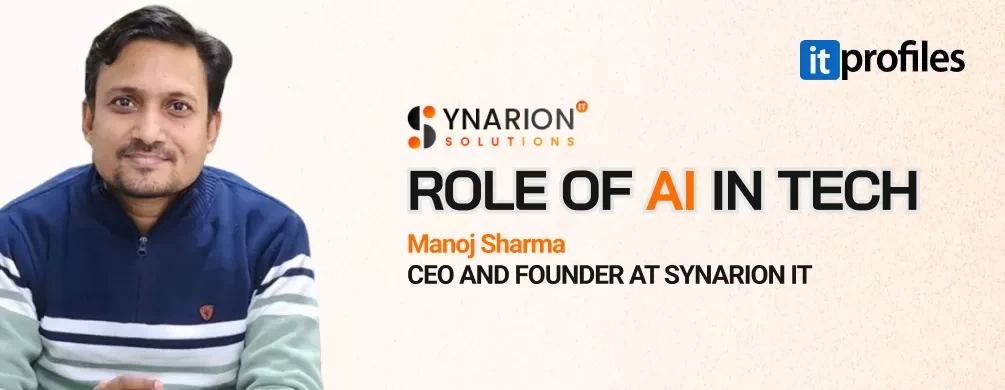
Manoj Sharma of Synarion IT Solutions
At Synarion IT Solutions, AI isn’t just a tool for one function - it’s reshaping the entire development lifecycle. Manoj Sharma, CEO of Synarion (synarionit.com), highlights the areas where the impact has been most visible.
“AI assists in generating boilerplate code and automating repetitive tasks, which significantly reduces development time,” he explains. Testing and quality assurance have also seen a major leap forward, with AI-powered tools detecting bugs, optimizing test coverage, and predicting potential issues faster than manual testing.
The company is also leveraging AI for data analysis and insights, enabling smarter app features such as recommendations and predictive analytics. On the user side, AI-driven analytics help refine UI/UX, making applications more engaging and personalized.
Even project management has benefited. “AI predicts timelines and resource needs more accurately, improving delivery efficiency,” Sharma adds.
By integrating AI into coding, QA, data handling, and planning, Synarion has positioned itself to deliver solutions that are not only faster but also smarter and better aligned with client expectations.
For Synarion IT Solutions, bringing AI into live projects has been as much about overcoming obstacles as it has been about unlocking opportunities. Quality and accuracy often sit at the top of the list, as Manoj Sharma explains:
“Making sure AI models stay reliable and consistent isn’t always easy, especially when datasets are limited or biased.”
Ethical concerns also remain a constant. Ensuring fairness and preventing bias in AI-driven decisions requires continuous oversight. Security is another pressing factor, with Sharma noting that AI systems “need strong protection to prevent data breaches or misuse.”
Compliance adds further complexity, particularly when working across regions with strict data privacy laws such as GDPR. And even when those hurdles are addressed, the technical side presents its own challenges - integrating AI seamlessly into existing workflows without disruption is no small task.
When asked what guidance he would give to companies exploring AI, Manoj Sharma emphasizes the importance of focus and practicality. Businesses, he says, should avoid chasing AI for its hype and instead “start with areas where AI clearly adds value - whether that’s improving efficiency, enhancing user experience, or generating insights.”
He suggests starting with a small pilot project, measuring the outcomes, and then scaling up further. This approach, Sharma explains, not only reduces risk but also ensures ROI while giving teams the time to adapt to AI responsibly.
Easily connect with top-qualified providers for your project. Post your requirements for free, and let our data-backed insights and experts match you with the best service providers.
Looking ahead, Manoj Sharma sees AI becoming deeply embedded across the software development lifecycle. He believes that tools for AI-assisted code generation and auto-completion will soon become mainstream, reducing development time and making coding more accessible.
Testing and quality assurance are also set for transformation. “AI-powered testing and predictive maintenance will dominate,” Sharma notes, pointing to the way automation can boost reliability and reduce human error.
Beyond the technical core, he highlights intelligent automation across workflows, from deployment to monitoring, as well as AI-driven personalization, which will give end users hyper-tailored experiences.
Sharma also draws attention to edge AI, where models run directly on devices for faster, real-time performance in areas like IoT, AR, and VR. Finally, he stresses the importance of explainable and ethical AI, especially as new regulations emerge. “Transparency and compliance will no longer be optional,” he says.
At Synarion IT Solutions, preparing the workforce for an AI-driven future is just as important as adopting the technology itself. Manoj Sharma explains that the company has made training a top priority, equipping developers with skills in machine learning, model integration, and data handling.
Teams are also being introduced to generative AI tools for coding, testing, and deployment, which Sharma says “boost productivity while freeing developers to focus on higher-value work.” Beyond the technical, the company is building data literacy and analytics skills, ensuring every team member can interpret and act on insights effectively.
Equally critical are ethics and compliance. Sharma emphasizes responsible AI usage, pointing out that data privacy and fairness in decision-making can’t be overlooked. To round it out, Synarion encourages cross-skilling, enabling developers to master multiple tech stacks and integration methods so they remain versatile as the industry evolves.
Even in an AI-first world, Manoj Sharma believes developers will remain at the center of innovation. While AI can generate code or automate repetitive tasks, it’s human developers who will define the vision, logic, and creative problem-solving that drive truly valuable solutions. “AI can assist, but the innovation still comes from people,” he notes. The future of development, then, is less about raw coding effort and more about guiding technology toward purposeful outcomes.
The rise of AI has also shifted what businesses expect from IT service providers. Clients are no longer satisfied with just functional software - they want smarter, faster, and more adaptive solutions. As Sharma puts it, “AI-powered features like predictive analytics, personalization, and automation are no longer optional - they’re becoming standard.”
AI-driven tools have also shortened delivery cycles, making faster timelines a baseline expectation. At the same time, businesses are demanding data-driven insights that go beyond dashboards, using AI to guide strategic decisions. Finally, the focus on enhanced user experiences - apps that adapt to user behavior in real time - has become a priority across industries.
Post a project for free and quickly meet qualified providers. Use our data and on-demand experts to pick the right one for free. Hire them and take your business to the next level.

ITProfiles is your trusted resource for finding the best IT companies for your development projects.
Built with love by diverse teams based in Denver (CO), Berlin (Germany), India, and Finland.