
In just three years, Coderfy has grown from a no-code backend experiment into a global digital partner for startups and businesses. Under CEO Den Mykhailo, the company now delivers mobile and web development, AI integration, custom software solutions, and web design services.
In this interview with ITProfiles, Den shares how Coderfy is embracing AI to streamline workflows, enhance decision-making, and accelerate discovery, while emphasizing the irreplaceable role of human developers. He discusses the challenges and opportunities AI brings to development, how it is reshaping client expectations, and the strategies his team uses to integrate AI responsibly and effectively into everyday operations.
This conversation offers insight into the future of software development where human judgment and AI capabilities work hand in hand.


Find My Agency Takes only 2 mins, 100% free
 Table of Content
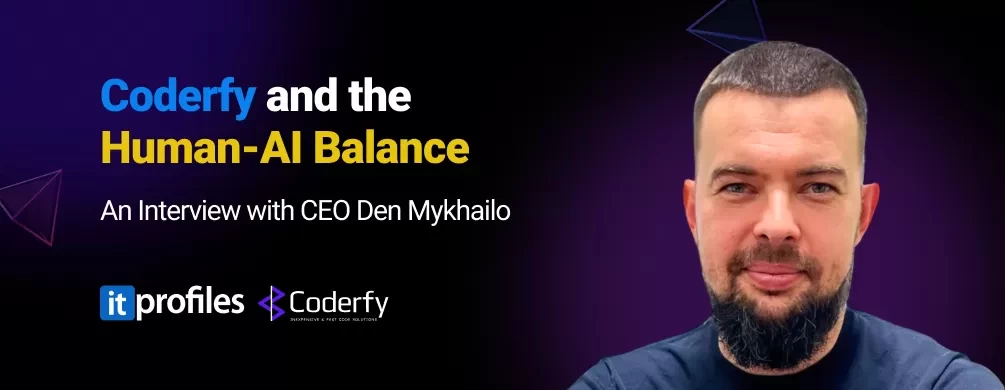
Den Mykhailo - CEO of Coderfy
Three years ago, Coderfy (coderfy.com) began as a small team experimenting with no-code backend solutions. Today, under the leadership of CEO Den Mykhailo, the company has evolved into a full-fledged digital partner for startups and businesses worldwide.
“We are Coderfy, and we started three years ago with a no-code backend and have now become a digital partner for startups and businesses across the globe,” says Den. What began as a niche focus on simplicity and rapid prototyping has grown into a diverse service offering that includes mobile and web development, AI integration, custom software solutions, and even web design.
For Den and his team, Coderfy’s mission remains rooted in adaptability - helping clients turn ideas into functional, scalable digital products through the right balance of innovation, speed, and strategy.
Den Mykhailo recalls Coderfy’s first encounter with AI back in autumn 2022. “We started by building AI-based chatbots, primarily for customer support and content generation,” he says. The team initially aimed to promote these solutions in English-speaking markets, but the early efforts didn’t gain the traction they hoped for. “We finished using those on our own,” Den admits with a laugh.
That early experimentation, however, proved invaluable. When AI adoption became mainstream, Coderfy was already prepared to adapt quickly. Today, Den uses several custom AI models daily to streamline operations. “We use AI to estimate and make discoveries at different levels on a presale stage to cover speed expectations, note meetings, and produce summaries,” he explains.
For Coderfy, AI has become a reliable tool for what Den calls “generic work” - the behind-the-scenes processes that save time, improve accuracy, and allow the team to focus on building meaningful digital products.
When asked about where AI has made the most impact, the response was clear and practical - pre-sales, accounting, and project management have all seen major improvements. According to him, AI is now deeply integrated into the administrative layer of management, streamlining communication, negotiations, and RFP analysis to reduce “noise” in data and requirements.
Interestingly, while the leadership team leverages AI for operational and strategic efficiency, developers have also started to see benefits. From issue detection and bug fixing to simplified coding assistance, AI tools are quietly reshaping both executive workflows and hands-on development tasks. The company continues to experiment with new AI-driven processes, finding that even small automations can lead to measurable gains in productivity and accuracy.
“Use AI to form quick hypotheses and keep your projects moving,” says Den. “It’s incredibly useful for discovery, niche analysis, and understanding market demand - but only when paired with critical thinking and real expertise. AI should support your team’s competence, not replace it.”
He also offers a practical tip for those looking at pre-built tools:
“When it comes to ready-made AI solutions, try it before you buy it. There’s a lot of buzz in the market right now, and not every vendor delivers on their promise. You need to separate the real doers from the L-AI-ers.”
And finally, on whether traditional software is becoming obsolete: “Not at all. Software without AI still has a strong future - but I’d invest in teams and solutions that leave space for AI integration. That’s how forward-thinking companies view it today.”
Share your project details with us for free, and get matched with experienced providers. Use our insights and expert recommendations to confidently choose the right partner for your needs.
“Oh, that would be great to know - and move in that direction,” Den says with a laugh. “As I see it, data analysts are becoming increasingly in demand, so I believe the next few years will be dominated by data-driven software and AI-powered content generation. These technologies drastically reduce costs and make teams more efficient.”
He adds, “AI is starting to level the playing field for everyone. But when companies invest in technology now, it’s not just about automation - it’s also about building long-term marketing and business value. AI is becoming part of the story behind every big deal. I’ve been using AI note-takers and grammar checkers for years, and as a marketer and business developer, I can say it accelerates the go-to-market process tenfold.”
Den also shares his CTO Bohdan’s technical forecast for the next wave of AI in development:
Automated AI pull request reviews
Automated debugging
AI-generated backend and frontend test writing
AI-built basic backend functions (CRUD, payments, logins, etc.)
And eventually, seamless Figma-to-AI frontend generation
“It’s exciting,” Den concludes. “We’re heading toward a world where AI doesn’t replace developers - it removes the repetitive parts, letting us focus on creativity and product logic.”
Den Mykhailo reflects on the enduring importance of human insight in a landscape increasingly influenced by AI.
“That’s a tricky question, but I hope we remain thinkers in this chain,” he says. Developers must see the whole picture, lead, and manage the process, rather than being led solely by AI outputs. At the same time, he stresses the need for humility and responsibility regarding the impact of AI-driven decisions. For him, human judgment remains central to shaping meaningful, ethical, and effective digital solutions.
At Coderfy, Den emphasizes practical adoption over formal training. “We encourage the team to avoid generic work and dummy processes, improve wherever they see an opportunity, and follow our approach,” he explains. The focus is on integrating AI naturally into daily workflows, rather than treating it as a separate skill to master.
The company also pays attention to how interns and new candidates use AI, even evaluating the quality and intelligence of their AI usage. “We don’t make it a formal part of growth,” Den says, “mostly, we use it when it fits.”
In his words, Coderfy’s approach is like Googling 2.0, sometimes diving much deeper - leveraging AI not just to complete tasks, but to enhance discovery, insight, and decision-making across projects.
AI is also transforming what clients expect from IT service providers. “Speed, low cost, innovation, and even miraculous results are the most noted expectations,” Den explains. Clients often arrive with partial visions or vague ideas, using AI to fill in the gaps. While AI can help, it rarely captures the full scope of business value and functionality on its own.
He continues, “They expect us to provide the missing part - guidance, advice, and tailored solutions. When clients do their homework, we just fine-tune. But it doesn’t work when AI replaces critical thinking entirely.”
AI’s data analysis capabilities at the enterprise level allow requirements to be better defined before the estimates and discovery phases. While this makes projects more original and often unique, it also reduces the opportunities for developers to influence early design decisions - highlighting the importance of human expertise in interpreting and guiding AI-assisted insights.
Post a project for free and quickly meet qualified providers. Use our data and on-demand experts to pick the right one for free. Hire them and take your business to the next level.

ITProfiles is your trusted resource for finding the best IT companies for your development projects.
Built with love by diverse teams based in Denver (CO), Berlin (Germany), India, and Finland.