
Just a few years ago, access to expertise was a competitive advantage.
Today, access to AI is nearly universal.
For less than the cost of a monthly software subscription, businesses can generate marketing copy, build prototypes, create designs, write code, automate customer support, and analyze data. Tasks that once required specialized teams can now be completed in minutes.
The result is a technological shift unlike anything most industries have experienced before. Execution is becoming faster, cheaper, and increasingly automated.
But as AI-generated content, AI-powered support, and AI-assisted development become commonplace, a new question is emerging:
If execution becomes abundant, what becomes scarce?
To explore that question, ITProfiles spoke with seven technology leaders from agencies and top software companies operating across different markets and industries. We originally asked a straightforward question: Is human support becoming the new luxury feature?
The answers quickly moved beyond support.
Rather than debating whether AI would replace humans, most of the CEOs and founders focused on something else entirely: the changing value of human judgment. Again and again, they returned to concepts such as accountability, context, intuition, trust, learning, and decision-making.
What emerged wasn't a simple argument for humans over machines. Nor was it a celebration of AI replacing people.
Instead, it revealed a growing consensus among technology leaders: as AI commoditizes execution, uniquely human capabilities may become the most valuable asset a company can offer.
Before diving into the individual insights, here's a snapshot of where the seven technology leaders aligned.
| Question | CEOs Who Agreed |
|---|---|
| Is human judgment becoming more valuable as AI makes execution cheaper? | 100% |
| Will AI change where value is created rather than replace human expertise altogether? | 100% |
| Is business context becoming a greater competitive advantage than technical execution alone? | 86% |
| Do customers still expect human accountability when outcomes matter? | 86% |
| Is the future of work a collaboration between humans and AI rather than humans vs. AI? | 100% |
| Will uniquely human skills like judgment, learning, communication, and taste become stronger differentiators? | 100% |
| Will companies increasingly compete on trust, context, and decision-making by 2030? | 86% |


Find My Agency Takes only 2 mins, 100% free
 Table of Content
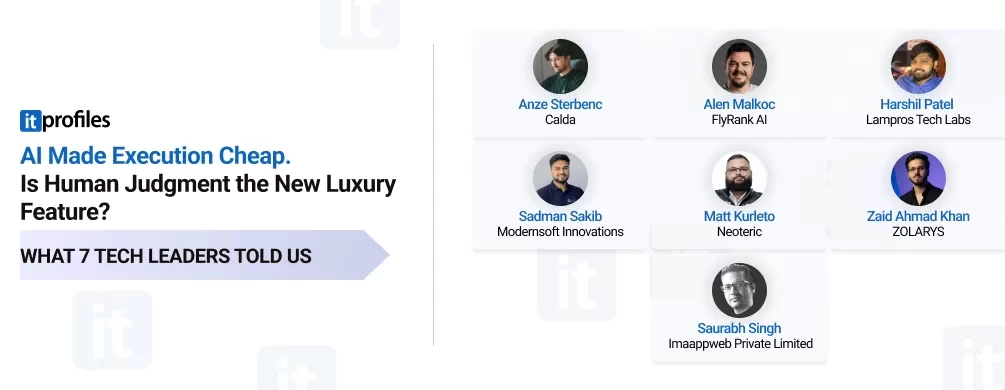
Seven technology leaders discuss why human judgment may become a premium differentiator as AI automates execution.
One of the strongest themes across all seven interviews was that clients are no longer paying primarily for output.
They're paying for decisions.
This distinction matters because AI is becoming increasingly capable of producing outputs. It can generate content, write code, create designs, summarize research, draft emails, and automate workflows at a speed that would have seemed impossible only a few years ago.
What it cannot reliably do is determine which output is actually right for a specific business context.
That distinction appeared repeatedly throughout the interviews.
As Lampros Tech Labs's CEO Harshil Patel explained, the value isn't necessarily in access to the tool itself:
"Choosing the right tool, knowing how to use it properly, understanding the business context, and turning the output into something reliable still requires human judgment."
This idea was echoed from a different angle by Zaid Ahmad Khan of ZOLARYS, who argued that businesses are not simply paying for deliverables anymore.
They are paying for the thinking behind them.
According to Khan, AI can quickly generate multiple options, but it cannot determine which option best aligns with a company's goals, customers, history, or market realities.
That gap between generation and decision-making is becoming increasingly important.
Perhaps no respondent articulated this more directly than Alen Malkoc of FlyRank.
In his view, clients are not paying a premium for execution itself.
They're paying for judgment and accountability.
"What clients are actually willing to pay a premium for is judgment and accountability. And those happen to still be human, for now."
That observation reflects a broader shift occurring across knowledge industries.
When content generation becomes cheap, content strategy becomes more valuable.
When coding becomes easier, architectural decisions become more important.
When customer support becomes automated, escalation management becomes critical.
The economic value begins moving up the decision chain.
A similar observation came from Sadman Sakib of Modernsoft Innovations, who argued that AI is not eliminating value creation so much as redefining where value is created. As routine technical execution becomes increasingly automated, businesses place greater emphasis on the human capabilities surrounding that execution, understanding objectives, making trade-offs, and ensuring technology delivers meaningful outcomes rather than simply producing outputs.
In his view, the competitive advantage no longer comes from performing routine work faster than everyone else. It comes from understanding which problems are worth solving and how technology should be applied to solve them.
This perspective also aligns with a growing body of management research. Organizations such as Harvard Business Review and McKinsey & Company have increasingly emphasized that AI's greatest impact may not be replacing expertise altogether, but reshaping where expertise creates value.
In practice, that means the most successful teams may not be those that avoid AI. They may be the teams that know exactly where AI should stop and human judgment should begin.
Several interviewees pointed to real-world examples of this phenomenon.
Clients arriving after AI-led projects that technically worked but somehow felt incomplete.
Solutions that looked acceptable on paper but failed to capture the unique identity of the business.
Deliverables that checked every box yet missed the underlying objective.
As Khan observed, AI often optimizes for what is acceptable. Businesses still need people capable of deciding what is memorable.
This same idea appears throughout several of the contributors' published perspectives, including FlyRank's discussion of outcomes over outputs and Lampros Tech Labs' exploration of human judgment in an increasingly automated environment.
The common thread is clear:
Execution is becoming easier.
Knowing what deserves execution is becoming harder.
And increasingly valuable.
One of the most interesting findings from these interviews wasn't what the CEOs said about AI.
It was how differently they framed the conversation.
Much of the public discussion around artificial intelligence revolves around fear.
Will AI replace jobs?
Will support teams disappear?
Will developers become obsolete?
Will agencies shrink?
These concerns are understandable. Entire professions are being reshaped in real time.
Yet when technology leaders discuss AI internally, they often approach the issue from a different perspective.
Rather than asking:
"What work can AI take away?"
They ask:
"What becomes valuable after AI takes that work away?"
That difference in framing explains much of the apparent disconnect between executives and employees.
Workers naturally focus on task replacement.
Leaders focus on value creation.
Across the interviews, very few respondents dismissed the disruptive potential of AI.
In fact, several openly acknowledged it.
What stood out, however, was that almost none of them framed AI as a simple replacement technology.
Instead, they viewed it as a force that reallocates value.
For example, while public discussions often position empathy as the defining human advantage, many of the CEOs interviewed focused on different capabilities entirely.
They spoke about:
accountability
context
learning
taste
communication
strategic thinking
relationship building
These are not necessarily tasks.
They are judgment-based competencies.
As explained by Matt Kurleto of Neoteric, who identified a surprisingly simple skill as his company's primary focus for the coming year:
"Learning. Learning is most important."
That answer reflects a broader executive perspective.
If AI capabilities continue evolving rapidly, static expertise becomes less valuable than the ability to continuously adapt.
Similarly, Alen Malkoc argued that one of the most important differentiators is something he calls "taste."
Not creativity in the abstract.
Not strategy as a buzzword.
Taste.
The ability to evaluate multiple possible outputs and recognize which one is genuinely worth pursuing.
"The ability to look at ten AI-generated outputs and instantly know which one is going to land."
That isn't a skill most employees worry about when reading headlines about automation.
Yet it may become one of the defining professional advantages of the next decade.
Interestingly, several CEOs also challenged common assumptions about intuition itself.
While many business leaders celebrate instinct, the respondents tended to describe intuition less as magic and more as accumulated experience.
Pattern recognition.
Market familiarity.
Years of observing what works and what fails.
In other words, the very capabilities that become difficult to automate are often the result of deep exposure to real-world complexity.
This may explain why several respondents expressed relatively little interest in promoting a "humans versus AI" narrative.
They don't see the future as a competition between people and machines.
They see it as a competition between people who effectively use AI and people who don't.
As Kurleto put it:
"AI is like another team member. Not a one-for-all."
That perspective introduces an important nuance often missing from broader public conversations.
The future may not belong to organizations that are entirely human.
Nor to organizations that are entirely automated.
Instead, it may belong to those who understand which forms of value remain uniquely human and build their businesses around them.
For years, technology companies competed on execution.
Who could build faster.
Who could deliver more features.
Who could process more tickets.
Who could generate more output.
Artificial intelligence is rapidly changing that equation.
Today, a growing number of businesses have access to similar AI tools, similar language models, similar automation platforms, and increasingly similar capabilities. As those technologies become more widely available, the advantage shifts elsewhere.
Several of the leaders interviewed by ITProfiles argued that context, not technology itself, is becoming the true differentiator.
This distinction is easy to overlook.
An AI model can generate a recommendation.
It cannot fully understand the political dynamics inside a client's leadership team.
It can draft a strategy.
It cannot always identify the unstated concerns driving a stakeholder's decision.
It can analyze historical data.
It cannot easily understand cultural nuances, local market realities, or the informal relationships that often determine whether a project succeeds or fails.
This theme emerged repeatedly across the interviews.
Saurabh Singh emphasized that engineering expertise is becoming less about writing code and more about understanding systems, trade-offs, and business objectives. In his published interview with IMA AppWeb, he describes a future where intelligence becomes embedded throughout engineering processes, but where human understanding remains essential for directing that intelligence toward meaningful outcomes.
Similarly, Anže Šterbenc of Calda argued that businesses are moving beyond AI hype and increasingly focusing on actual value creation. The challenge is no longer whether AI can generate an answer. The challenge is determining whether that answer solves the right problem.
This distinction sounds subtle.
In practice, it is enormous.
Many organizations today are discovering that AI can dramatically accelerate execution while simultaneously amplifying mistakes.
A poorly framed question can produce a faster wrong answer.
An incomplete understanding of customer needs can generate more irrelevant content.
An unclear strategy can lead to more efficient misalignment.
The technology works.
The context does not.
That is why several respondents repeatedly returned to the importance of understanding the human side of business.
Not in an emotional sense.
In a practical sense.
Understanding:
customer expectations
organizational priorities
stakeholder concerns
industry realities
competitive pressures
These are factors that rarely appear inside a prompt.
Yet they often determine whether a project creates value.
As Harshil Patel observed, the challenge isn't simply producing outputs. It is understanding how those outputs fit within a larger business context. A recommendation that appears logical in isolation may be completely inappropriate once operational constraints, customer expectations, and organizational realities are considered.
This is where human expertise increasingly earns its premium.
Not because humans can perform tasks faster.
But because humans can understand why a task matters in the first place.
The irony is that AI may actually increase the value of contextual thinking.
When execution becomes easy, the cost of poor judgment rises.
A company can now generate hundreds of strategic recommendations in an afternoon.
Choosing the right one may become the hardest part.
This shift has significant implications for agencies, consultants, software companies, and support teams.
Historically, expertise was often measured by output volume.
How much work could be delivered.
How many requests could be processed.
How many tasks could be completed.
Increasingly, expertise may be measured by something else:
The ability to understand context before deciding what should happen next.
And unlike many technical capabilities, that advantage is remarkably difficult to automate.
One of the most surprising findings across the interviews was what did not emerge as the primary argument for human value.
The expected answer would have been empathy.
After all, most discussions about human support eventually arrive at emotional intelligence, compassion, or relationship-building.
While those qualities certainly appeared, many CEOs focused on something different:
Accountability.
Again and again, respondents suggested that customers do not simply want answers.
They want someone responsible for those answers.
This distinction becomes particularly important when outcomes matter.
A chatbot can explain a policy.
An AI assistant can provide troubleshooting steps.
An automated workflow can process a request.
But when a project fails, a deadline slips, or a business-critical decision turns out to be wrong, customers often look for something technology cannot easily provide:
Ownership.
Several leaders described this dynamic from different angles.
Alen Malkoc argued that judgment and accountability remain among the most valuable services businesses provide.
His observation cuts directly to the heart of the issue.
An AI system can generate recommendations.
It does not bear responsibility for the consequences.
A consultant does.
A founder does.
A support leader does.
A technology partner does.
That accountability creates trust.
And trust creates value.
The same theme appeared in comments from Zaid Ahmad Khan, who emphasized that businesses are ultimately paying for outcomes, not outputs. While AI can contribute significantly to execution, customers still expect human professionals to stand behind the final result.
This distinction may become increasingly important as AI-generated work becomes commonplace.
Imagine two competing service providers.
Both use similar AI tools.
Both have access to similar automation platforms.
Both can deliver comparable outputs.
What separates them?
Often, it is confidence.
Not confidence in the technology.
Confidence in the people operating it.
Who will take responsibility if something goes wrong?
Who will challenge a flawed recommendation?
Who will identify a risk before it becomes a problem?
Who will adapt when circumstances change?
Those questions cannot always be answered by automation.
This may explain why several respondents connected trust more closely to accountability than to empathy.
Empathy helps customers feel understood.
Accountability helps customers feel protected.
Both matter.
But in high-stakes situations, accountability often becomes the stronger differentiator.
This dynamic is already visible across professional services, software development, consulting, and customer support.
Organizations increasingly use AI to improve efficiency.
Yet they continue to rely on human experts to validate decisions, manage exceptions, and assume responsibility for outcomes.
Rather than eliminating the need for human involvement, automation may be concentrating human involvement around the moments that matter most.
The routine interactions become automated.
The consequential interactions become human.
And those interactions often carry the greatest value.
At first glance, the interviews seem to point toward a simple answer.
Yes.
As automation expands, human support becomes more valuable.
Human interaction becomes rarer.
Therefore, human support becomes a luxury feature.
But the reality is more complicated.
And several CEOs challenged that conclusion directly.
This was one of the most interesting disagreements in the entire dataset.
The majority of respondents agreed that human expertise is becoming more valuable.
Where they differed was in what that actually means.
Some leaders effectively argued that meaningful human involvement is increasingly behaving like a premium service.
As AI handles routine interactions, access to experienced professionals becomes concentrated around higher-value situations.
The result resembles what has happened in other industries.
When something becomes automated and abundant, personalized human attention often becomes more desirable.
We see this in hospitality.
Financial advisory services.
And increasingly, technology services.
From this perspective, human support isn't disappearing.
It is moving upmarket.
Customers may interact with AI for routine questions, basic troubleshooting, scheduling, documentation, and simple requests.
Human experts become involved when nuance, judgment, strategy, or risk enters the conversation.
That model appeared repeatedly across the interviews.
Yet not everyone viewed this trend through the lens of luxury.
Several respondents pushed back against the idea that "human" automatically equals "better."
This is an important distinction.
A human-only process can be:
slower
less consistent
more expensive
harder to scale
Likewise, an AI-assisted process can often produce superior outcomes.
The real advantage is not human involvement by itself.
The advantage is knowing where human involvement creates value.
This perspective emerged particularly strongly among leaders who viewed AI as a collaborative technology rather than a replacement technology.
In their view, customers are not paying for human labor.
They are paying for human judgment.
The difference matters.
A company does not gain a competitive advantage simply by refusing automation.
It gains a competitive advantage by combining automation with expertise.
This brings us back to the original question.
Is human support becoming a luxury feature?
The interviews suggest a nuanced answer.
Routine human support may not be.
Routine support is increasingly becoming automated.
What appears to be becoming more valuable is access to experienced humans during moments of uncertainty, complexity, and consequence.
Customers do not necessarily want more human interaction.
They want the right human interaction.
They want experts who can understand context.
Professionals who can make decisions.
People who can accept responsibility.
Individuals who can navigate ambiguity.
In that sense, human support increasingly resembles a luxury feature, not because humans are disappearing, but because meaningful human attention is becoming concentrated around higher-value moments.
And as automation continues to expand, those moments may become even more important.
If there was one area where the seven leaders showed near-universal agreement, it was this:
The future of human work is not disappearing.
It is becoming more specialized.
As AI systems continue to improve at execution, the most valuable human contributions increasingly come from capabilities that are difficult to codify, automate, or scale.
What's interesting is that the CEOs rarely described these capabilities as technical skills.
Instead, they talked about qualities that sit at the intersection of experience, judgment, and human understanding.
Matt Kurleto of Neoteric highlighted perhaps the simplest, and most overlooked, example:
"Learning is most important."
At first glance, that answer feels almost obvious.
Yet in a world where AI capabilities evolve monthly, the ability to continuously learn may become more valuable than any specific technical expertise.
Knowledge can be automated.
Learning cannot.
Several leaders also pointed toward intuition as a critical differentiator.
Not intuition in the mystical sense.
Rather, intuition as accumulated pattern recognition.
The ability to recognize subtle signals.
To identify risks before they become visible.
To understand why a decision feels wrong even when the available data appears correct.
This idea surfaced repeatedly across interviews discussing leadership, customer relationships, and strategic decision-making.
Another recurring theme was communication.
As AI becomes increasingly capable of generating information, the challenge shifts from producing answers to helping people understand them.
That requires translation.
Alignment.
Negotiation.
Persuasion.
Context.
These are deeply human skills.
They involve understanding motivations, concerns, incentives, and emotions that rarely appear in structured datasets.
Several respondents also highlighted relationship-building as a durable source of human value.
Relationships create trust.
Trust creates opportunities.
And trust is often built through consistency, transparency, and shared experience rather than efficiency alone.
This may explain why clients frequently remain loyal to advisors, agencies, consultants, and partners even when competing providers offer similar capabilities.
The relationship itself creates value.
Perhaps the most intriguing skill identified by the CEOs was what Alen Malkoc described as taste.
It's a concept that rarely appears in discussions about AI.
Yet it may become increasingly important.
Taste is the ability to evaluate possibilities and recognize quality.
To distinguish between something that is merely acceptable and something that is exceptional.
To understand what resonates with customers, audiences, stakeholders, and markets.
AI can generate hundreds of options.
Taste determines which one deserves attention.
Across all seven interviews, the emerging picture was remarkably consistent.
The most resilient human skills are not necessarily those that compete directly with AI.
They are the skills that guide AI.
The ability to ask better questions.
Frame better problems.
Make better decisions.
Build stronger relationships.
And ultimately, create meaning from abundance.
Share your project details with us for free, and get matched with experienced providers. Use our insights and expert recommendations to confidently choose the right partner for your needs.
One of the most revealing aspects of the interviews was what nobody argued for.
No CEO advocated abandoning AI.
Equally important, no CEO advocated a fully automated future.
Despite differences in perspective, almost every respondent ultimately arrived at some version of the same conclusion:
The future is hybrid.
This finding stands in sharp contrast to much of the public conversation surrounding artificial intelligence.
Popular narratives tend to gravitate toward extremes.
Either AI replaces humans.
Or humans reclaim their importance.
The leaders interviewed by ITProfiles described a different reality.
One where AI and humans perform fundamentally different roles.
AI delivers:
speed
scale
consistency
availability
automation
Humans provide:
judgment
accountability
context
adaptation
trust
Together, these capabilities create systems that are often stronger than either could achieve independently.
This perspective appeared repeatedly throughout the interviews.
AI handles repetitive requests.
Humans manage exceptions.
AI accelerates research.
Humans evaluate implications.
AI generates options.
Humans make decisions.
AI supports execution.
Humans provide direction.
The distinction is subtle but important.
Organizations that attempt to remove humans entirely may struggle with complexity and accountability.
Organizations that ignore AI may struggle with efficiency and scalability.
The most successful companies are increasingly finding value in combining both.
This is already visible in customer support.
Many businesses now deploy AI for first-line interactions while escalating complex issues to human specialists.
The same pattern is emerging in software development, consulting, marketing, design, operations, and professional services.
Routine work becomes automated.
Complex work becomes human.
In many ways, this mirrors previous technological shifts.
Spreadsheets did not eliminate accountants.
Search engines did not eliminate researchers.
Cloud computing did not eliminate IT professionals.
Instead, technology changed where value was created.
AI appears poised to do the same.
The winners may not be those who choose between humans and AI.
They may be those who build the most effective collaboration between the two.
The interviews were focused on the present, but they also offered clues about the future.
If AI continues improving at its current pace, many forms of execution will become increasingly commoditized.
Generating content.
Writing code.
Processing requests.
Conducting research.
Providing routine support.
The barriers to performing these tasks will continue falling.
This raises an important question:
What will companies actually compete on?
The answers provided by the seven leaders suggest several possibilities.
First, expertise itself may become more valuable, not expertise in execution, but expertise in decision-making.
As AI democratizes access to capabilities, businesses will increasingly need professionals who can determine which capabilities matter and when they should be used.
Second, trust is likely to become a stronger competitive differentiator.
As automated interactions become commonplace, organizations that consistently demonstrate transparency, accountability, and reliability may stand out more clearly.
Third, contextual understanding may emerge as one of the most important advantages a company can possess.
AI can understand patterns.
Humans understand circumstances.
The ability to connect technology with specific business realities may become increasingly valuable.
Fourth, learning may become a defining organizational capability.
Companies that adapt quickly to changing technologies will likely outperform those that rely on static expertise.
Finally, human attention itself may become more valuable.
Not because humans are inherently superior.
But because meaningful human involvement will increasingly be reserved for situations where it creates the greatest impact.
In a world overflowing with automated interactions, thoughtful human engagement becomes easier to notice, and often easier to remember.
Easily connect with top-qualified providers for your project. Post your requirements for free, and let our data-backed insights and experts match you with the best service providers.
Despite differences in emphasis and perspective, several clear themes emerged across the interviews.
Automation is no longer optional.
Routine tasks across support, development, marketing, and operations are increasingly becoming AI-assisted.
Every leader identified some version of judgment, context, intuition, or decision-making as a uniquely valuable capability.
The debate is not humans versus AI.
The future belongs to organizations that effectively combine both.
Customers may accept AI-generated outputs.
They still want humans to be responsible for outcomes.
Understanding a customer's business, goals, stakeholders, and constraints remains difficult to automate and increasingly valuable.
When ITProfiles asked seven technology leaders whether human support is becoming a luxury feature, the responses led somewhere unexpected.
The discussion quickly moved beyond support.
Beyond chatbots.
Beyond customer service.
And even beyond AI itself.
Instead, it became a conversation about value.
Specifically, what becomes valuable when execution is no longer scarce.
Across industries, AI is making it easier to generate content, build products, answer questions, automate workflows, and solve routine problems. Capabilities that once differentiated businesses are rapidly becoming accessible to everyone.
Yet the interviews suggest that this shift does not eliminate the need for human expertise.
It changes where that expertise creates value.
The leaders we spoke with repeatedly pointed toward the same qualities:
Judgment.
Context.
Accountability.
Learning.
Trust.
Relationship-building.
Not because AI lacks intelligence.
But because organizations still operate in environments filled with ambiguity, trade-offs, competing priorities, and human complexity.
That is where human value increasingly resides.
So, is human support becoming a luxury feature?
The answer is both yes and no.
Routine human support is unlikely to remain the default model. Automation will continue absorbing repetitive interactions and standard requests.
But access to knowledgeable humans during moments of uncertainty, complexity, and consequence is becoming more valuable, not less.
In that sense, human support is evolving into something closer to a premium capability.
Not because humans are disappearing.
Not because AI is failing.
But because as execution becomes abundant, meaningful human judgment becomes harder to replace.
And in a world where almost everyone has access to the same technology, that judgment may become one of the most important competitive advantages a business can offer.
Post a project for free and quickly meet qualified providers. Use our data and on-demand experts to pick the right one for free. Hire them and take your business to the next level.

ITProfiles is your trusted resource for finding the best IT companies for your development projects.
Built with love by diverse teams based in Denver (CO), Berlin (Germany), India, and Finland.