
The first conversation between a buyer and a technology agency can look deceptively simple. A discovery call begins, introductions are made, the buyer explains the project, and the agency prepares to demonstrate what it can do. But interviews conducted by ITProfiles with technology agency founders and senior leaders suggest that the evaluation may already be underway before the agency reaches its portfolio, technical capabilities, or proposal.
A buyer may have researched the agency beforehand, reviewed its previous work, looked for relevant experience, or formed an initial impression from the way the company presents itself online. By the time the first call begins, the agency may therefore be entering a conversation where some expectations, and some doubts, already exist.
The more important evaluation may happen during the conversation itself.
What does the agency ask first? Does it try to understand the business problem before proposing a technical solution? Does it recognize constraints the buyer has not mentioned? Does it listen carefully, communicate clearly, and challenge assumptions when necessary? And does the interaction make the buyer feel that the agency will reduce complexity and risk, or add to it?
These questions matter because agencies often approach the opening conversation from the perspective of what they need to demonstrate: technical expertise, delivery experience, team strength, technology stacks, and previous projects. Buyers may be assessing something different before any of those credentials become decisive.
They may be trying to determine whether the agency understands the problem well enough to make good decisions with them.
And that raises a more useful question than whether buyers are simply choosing the "best" agency: before an agency gets the chance to pitch its capabilities, what has the buyer already learned, and what might that early impression mean for the rest of the deal?


Find My Agency Takes only 2 mins, 100% free
 Table of Content
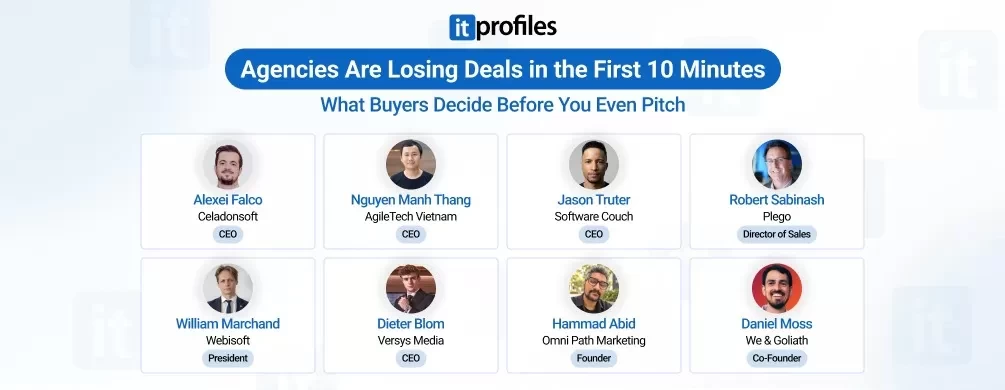
The first sales call is not necessarily the beginning of the buyer's evaluation. In several of the responses, it is closer to the point where an existing impression gets tested.
Half the respondents said buyers typically begin forming their view before contacting an agency. Others placed the turning point during the first conversation, negotiations, or after comparing proposals. That spread matters because it shows that the buying process is not a single event.
Before contacting an agency, a buyer can examine its website, portfolio, case studies, reviews, leadership team, and previous projects. For buyers researching software development partners, ITProfiles provides agency listings, project information, reviews, and comparative signals that can help narrow the field.
That research does not necessarily produce a final decision, but it can establish an initial expectation about whether the agency is relevant, credible, and worth a conversation.
William Marchand, President at Webisoft, described the pre-call research in unusually concrete terms:
"Before a buyer ever speaks to you, they've already checked your website, LinkedIn, case studies, reviews, team, and probably searched your company name. If that research doesn't quickly prove that you've solved problems like theirs before, the first call starts with a trust deficit."
That is more than a marketing observation. It changes the starting conditions of the sales conversation.
An agency whose public presence demonstrates relevant experience gives the buyer a reason to believe the conversation will be useful. An agency whose presence is dominated by broad service descriptions may have to establish relevance from scratch.
The same pattern appears in Daniel Moss's response from We & Goliath. He said buyers are checking whether an agency understands their specific situation or whether they are about to receive a generic pitch. The point is not simply that buyers browse websites. It is that they use the information available before the call to form a hypothesis about the agency.
That makes the agency's public-facing material part of the buying conversation. It also explains why transparent evaluation criteria matter when buyers are comparing agencies before making contact.
A relevant case study can signal familiarity with a problem. The same applies when buyers are researching web development companies, where portfolios and demonstrated outcomes can provide an early indication of relevance. A named business outcome can make an agency's experience easier to recognize. A clear explanation of who the agency helps can reduce ambiguity before anyone has spoken to a salesperson.
The first call then has a difficult job: it must validate the buyer's initial impression or give the buyer a reason to change it.
This is where the "first 10 minutes" idea becomes useful as an editorial lens rather than a literal stopwatch. The early interaction may not produce a final decision, but it can establish the starting frame.
If the buyer has already concluded that an agency is relevant, the first call can deepen that confidence. If the buyer arrives with doubts, the agency has to overcome them while also understanding the project.
That is why the first conversation is not really starting from zero.
The buyer may already have formed a hypothesis about the agency.
The agency's job is to give the buyer a reason to update it.
Once the first conversation begins, the agency's instinct is often to explain what it can do. The interviews suggest that this may be precisely the moment when a different approach becomes more valuable.
The strongest early signal may not be the sophistication of the presentation, but the quality of the questions.
Across the responses, agency leaders repeatedly returned to the importance of understanding the business context before discussing implementation. What is the company trying to achieve? What is not working today? Who uses the product or process? What constraints exist? What has already been tried? What happens if the underlying problem remains unresolved?
These questions do more than help an agency collect requirements. They give the buyer an early indication of how the agency thinks.
Alexei Falco, CEO of Celadonsoft, described the distinction between a capability-led and problem-led conversation:
"They want to know if you'll jump straight into 'how many developers' or if you'll pause to understand why they're building this system and what they've already tried that failed. They're testing whether you bring clarity or just capacity."
The key phrase is "clarity or just capacity."
A buyer already knows an agency can sell development capacity. The harder question is whether the agency can make an ambiguous problem easier to understand.
Alex's answer to what signals that understanding was equally specific. He pointed to operationally specific, non-technical questions before talking about solutions, including questions about inventory, disconnected systems, compliance audits, workflows, and bottlenecks.
That distinction is easy to overlook because discovery is often treated as a procedural stage of the sales process. Agencies need information before they can estimate scope, assemble a team, or prepare a proposal. But discovery can also become a demonstration of expertise in its own right.
An agency that immediately starts discussing React, Node, cloud infrastructure, or development timelines may be demonstrating familiarity with technology. It may still leave the buyer wondering whether anyone has understood the business problem underneath the requested solution.
An agency that asks why the system is needed, what operational problem it is supposed to solve, and what has already gone wrong is demonstrating something different.
It is showing that the technology conversation has a business context.
The question itself becomes evidence.
A company may approach an agency asking for mobile app development when its deeper issue is customer retention. It may request an automation platform when the underlying bottleneck is an inefficient internal process. It may ask for a particular feature because that is how the problem has been framed internally, even though another intervention could achieve the same business objective more efficiently.
A purely transactional agency can accept the brief and begin estimating.
A consultative agency has an incentive to investigate it.
Robert Sabinash, Director of Sales at Plego, described the same signal from the buyer's side:
"They ask thoughtful questions specific to the buyer's business, instead of immediately pitching their services."
That is a small behavioral difference, but it can change the buyer's perception of the agency's role. Instead of another vendor waiting to receive requirements, the agency starts to look like a team capable of helping define them.
This also explains why generic discovery calls can create doubt even when the agency behind them is highly capable. If the questions could have been asked of any prospective client, the buyer has little reason to believe the agency has understood this particular one.
The opposite is also true.
A precise question can make a buyer reconsider the agency's role in the conversation.
The shift is from "What do you need built?" to "What are you trying to accomplish?"
The first question positions the agency as an executor.
The second positions it as a problem solver.
That does not mean agencies should ignore requirements, technology, or delivery constraints. Those details eventually matter enormously. It means they may be more useful after the agency understands why they matter.
The first conversation should therefore not be optimized only for information extraction or presentation. It should be optimized for mutual understanding. That distinction is also central to the practical process of defining requirements, evaluating development approaches, and choosing a delivery partner.
The buyer should leave knowing that the agency understood the problem more clearly than it did at the beginning.
And the agency should leave knowing not simply what the buyer wants built, but why it wants it, what success looks like, what could prevent it, and where the original brief may need to be challenged.
That is a very different definition of a successful first call.
The agency has not necessarily sold anything yet.
But it has demonstrated something potentially more valuable than another capabilities slide: it knows how to think about the problem.
There is a deeper idea running through the interviews than simply "ask better questions." Several leaders suggest that buyers are watching for something harder to demonstrate: whether an agency is willing to use its expertise in the client's interest, even when that means challenging the brief.
That is a very different proposition from proving that an agency can execute.
An agency can demonstrate technical expertise by explaining its architecture capabilities, naming its technology stack, or showing a sophisticated portfolio. But those signals answer a relatively straightforward question: Can you build this?
The more consequential question may be: Should we build this at all, and if so, what is the right way to approach it?
Nguyen Manh Thang, CEO of AgileTech Vietnam, identified one of the clearest trust signals:
"The strongest signal is when the agency actively advises the client not to build a certain complex feature right away. When an agency examines a product roadmap and says, 'We can build this custom module, but using a ready-made service or simpler workflow will save you 2 months of development and 40% of your budget,' the buyer instantly knows they are dealing with an honest engineering partner."
The value of that advice is not just technical. It is commercial restraint.
If a ready-made service or simpler workflow can save two months of development and 40% of the budget, recommending it can demonstrate more credibility than promising to build the custom solution. The agency is effectively putting the client's outcome ahead of maximizing its own scope.
That distinction matters because buyers are not only purchasing execution. They are also handing an agency a degree of decision-making authority.
Once an external team is involved in product architecture, integrations, automation, software development, or digital transformation, its recommendations can influence costs and timelines long after the initial contract is signed. A buyer therefore has reason to look for evidence that the agency will exercise that influence responsibly.
Expertise is not the same as saying yes.
The conventional sales dynamic rewards agreement. A buyer describes what they want. The agency says it can deliver. The conversation moves toward scope, timelines, and price.
But agreement can sometimes be a weak signal.
A capable agency should be able to recognize when the requested solution contains an unnecessary feature, an architectural weakness, an unrealistic assumption, or a simpler alternative.
That does not mean challenging the client for the sake of appearing clever. It means having enough understanding of the business and technical context to distinguish between a requirement that matters and one that has simply become embedded in the brief.
Thang's example goes further. In a complex AI platform engagement, his team did not simply ask for the product requirements document. They presented a live breakdown of potential latency issues in the proposed data pipeline and offered two concrete architectural fixes.
The important signal was not merely that the agency knew how to solve a technical problem.
It was that the agency identified the problem before the buyer had to discover it through an expensive implementation.
That is a particularly powerful form of credibility because it connects technical expertise to business protection.
The buyer does not have to take the agency's word for it.
The agency has demonstrated its thinking.
From feature factory to risk-reduction partner
Alex, CEO of Celadonsoft, described a deal in which the buyer quickly understood a distinction between his agency and a previous provider:
"The buyer immediately understood that we are not a 'feature factory' - we are a risk-reduction partner."
The buyer had previously worked with an agency that jumped straight into development, delivered a system that could not handle 10x growth, and left substantial technical debt. Celadonsoft's pre-development discovery, structured handover process, and domain experience changed the conversation.
Alex said the buyer "got" that the agency charged for clarity and predictability, not just hours. That is an important distinction in an industry where agencies often compete by emphasizing the resources they can provide.
The interviews suggest that resource capacity may be only one part of the value equation.
A buyer may also be asking whether those resources will be used to avoid expensive mistakes.
The strongest early challenge may be the one that changes the brief.
That is where the first conversation can become more than a qualification call. If an agency identifies a problem that changes how the buyer thinks about the project, it has already created value before a contract exists.
Daniel Moss described this behavior as "naming the real problem before the buyer says it out loud." His response points to a recurring pattern in complex purchases: the stated request may not be the underlying problem. The agency that simply responds to the stated request may solve the wrong problem efficiently. The agency that investigates what sits underneath it may discover a different opportunity.
This is why the strongest discovery questions matter so much. They can lead to a change in the problem definition itself.
And when an agency can do that credibly, the conversation shifts.
The buyer is no longer simply asking, "Can you build what I requested?"
They are considering, "Have you seen something here that I haven't?"
That is a much harder form of differentiation for competitors to replicate.
The broader lesson is that expertise is difficult to establish through credentials alone.
A portfolio can demonstrate experience. A technology stack can demonstrate technical familiarity. Certifications can demonstrate knowledge.
But judgment has to be observed.
It appears in the question that challenges an assumption.
It appears in the recommendation to use an existing service rather than commission unnecessary custom development.
It appears in an architectural warning raised before implementation.
It appears when an agency refuses to promise something simply because the client wants to hear it.
These behaviors give the buyer a small preview of how the agency may behave once the project becomes complicated.
Will the agency simply execute instructions?
Or will it take responsibility for helping the buyer make better decisions?
That distinction may not determine every deal. Pricing, technical requirements, proposals, procurement processes, and negotiations still matter.
But when agencies appear broadly comparable, the ability to demonstrate independent judgment in service of the client's outcome can become a meaningful differentiator.
Share your project details with us for free, and get matched with experienced providers. Use our insights and expert recommendations to confidently choose the right partner for your needs.
Trust is one of the most frequently used words in agency sales. Almost every agency says it wants to build trust with prospective clients. But the interviews suggest that buyers may experience trust in a much more practical way.
They are not simply asking whether they like the people on the call. They are trying to determine how much risk comes with handing the problem to this agency.
That risk can take several forms. There is technical risk: Will the system work? Will the architecture scale? Will integrations behave as expected? There is financial risk: Will the budget hold? Will scope expand unexpectedly? And there is operational risk: Will the agency communicate when something goes wrong, take ownership of problems, and give the client enough visibility to make decisions?
William Marchand identified trust as the factor most likely to break a tie between similarly capable agencies.
Robert selected communication. Hammad Abid also selected trust.
These answers point toward a practical definition of trust: predictability.
A buyer wants evidence that the agency will surface problems rather than hide them, explain uncertainty rather than gloss over it, and make the project easier to manage rather than harder.
Hammad Abid, Founder of Omni Path Marketing, emphasized transparency and listening during the first client interaction, followed by the importance of the agency's first audit report. His wording is blunt:
"Transparency. You have to listen to the client during the first call. After that, your first audit report of their business lets the client know that they're in either safe hands or they're doomed."
The underlying point is clear. Buyers need to see a process that creates visibility into the problem rather than simply receiving a promise that the agency can solve it. An agency saying "We have done this before" asks the buyer to trust its claim. An agency showing how it would investigate the problem gives the buyer something concrete to evaluate.
The second approach moves trust from assertion to evidence. That demand for evidence is also showing up more broadly in how technology buyers evaluate agencies, with increasing attention to proof, transparency, delivery teams, and measurable business value. This emphasis on evidence is consistent with broader B2B research. Gartner's 2026 survey found that 69% of B2B buyers prefer to validate AI-generated insights with sales representatives, while 51% said they are more likely to encounter misleading information from GenAI. The finding points to a broader role for human interaction: buyers may use digital and AI tools for research, but still look for validation and confidence when decisions become consequential.
Communication becomes a form of risk management. Clear communication is sometimes treated as a soft skill, something that improves the client experience after the contract has been signed. But in the context of early agency selection, it can function as evidence of operational reliability.
A buyer can reasonably ask:
If the agency communicates clearly during the sales process, will it continue doing so when the project encounters a problem?
If it explains uncertainty rather than hiding it, will it be transparent about delays?
If it asks questions rather than making assumptions, will it do the same once development begins?
The first conversation provides a small sample of the behavior the buyer may experience later. That makes responsiveness and clarity more consequential than they initially appear. Buyers are also evaluating what happens when the agency disagrees. Risk reduction does not always mean making the buyer comfortable.
Sometimes it means making the buyer uncomfortable at the right moment.
An agency that identifies an unrealistic timeline, questions a requested feature, or points out an architectural weakness is introducing friction into the conversation. Yet that friction can ultimately reduce risk.
The willingness to say "we don't think you should do this" can be more reassuring than saying "yes, we can build that."
It demonstrates that the agency's definition of success is not simply getting the contract.
There is an irony here. Agencies often believe they need to appear completely confident in order to win a deal. But excessive certainty can sometimes have the opposite effect. Complex technology projects contain uncertainty by definition. Requirements change. Integrations behave unexpectedly. Dependencies emerge. Business priorities shift.
A buyer who has experience with these projects may therefore be less interested in an agency that claims everything will be straightforward than in one that can explain where uncertainty lies and how it will be managed.
A good discovery process exposes unknowns early.
It distinguishes assumptions from facts.
It identifies dependencies.
It makes trade-offs visible.
And it gives the buyer a clearer picture of what the agency knows and what still needs to be investigated.
In that sense, transparency becomes a technical and commercial capability.
The buyer is also assessing something broader:
Will this agency make my job easier or harder?
That question rarely appears explicitly in an RFP, yet it can influence the perception of the relationship.
A technically capable agency that requires constant clarification, provides vague updates, or waits for the client to identify every problem may create management overhead. Another agency with comparable technical capabilities may proactively surface issues, explain decisions, and create a clearer path forward. The difference is not necessarily visible in a portfolio. It becomes visible in interaction.
The buyer is not only asking whether the agency can deliver the project.
They are trying to estimate what it will be like to have this agency responsible for the project. Before the contract exists, the agency is already demonstrating how it handles questions, uncertainty, disagreement, and accountability. Trust, in that sense, is less about likeability than predictability.
By the time a proposal arrives, the buyer has already experienced the agency in several ways.
They may have visited its website, reviewed its work, exchanged emails, attended a discovery call, and listened to how the team talks about the problem. The proposal is therefore not necessarily the first substantial piece of evidence the buyer receives. It is another piece added to an impression that has been developing throughout the process.
But the interviews contain an important counterpoint to any claim that the early conversation decides everything.
Robert, Director of Sales at Plego, said:
"Only after comparing multiple proposals."
Hammad Abid placed the decision later still, during negotiations.
So the evidence does not support a simple "the proposal does not matter" argument.
It supports something more nuanced: the proposal can be important without being the first place where the buyer starts forming a preference.
A proposal is interpreted through everything that came before it.
Imagine two agencies responding to essentially the same brief. Both have experienced teams. Both offer credible delivery processes. Both have relevant technical capabilities. One agency spent the first conversation investigating the buyer's operating model, customer journey, commercial objectives, and existing technical constraints.
The other spent most of the call explaining its services. The proposals may look equally professional. The buyer may not read them equally. The first proposal can feel like a continuation of a conversation. It can demonstrate that the agency understood the issues discussed and translated those issues into a specific approach.
The second may feel more like a response to an RFP. That distinction matters because specificity is one of the earliest credibility signals in the interviews.
Daniel Moss argued that buyers look for evidence that an agency has made an effort to understand their specific situation. If the agency's material focuses mainly on itself, its process, awards, and team, rather than outcomes the buyer recognizes, it can quickly appear generic.
That problem can carry into the proposal. If discovery was generic, the proposal has little specific information from which to build a differentiated recommendation. The document can still be attractive.But for buyers evaluating a web development partner, a polished proposal cannot replace evidence that the agency understands the business, audience, technical requirements, and expected outcome.
It can still be technically correct. But the buyer may struggle to see why this agency, rather than another equally capable one, should be selected.
The proposal can confirm a position or expose a gap. This is why proposal quality cannot be separated completely from discovery quality.
If an agency identifies a significant architectural risk during the first conversation, the proposal can explain how that risk will be addressed. If it discovers that the buyer's requested feature does not directly support the desired business outcome, the proposal can recommend a different approach.
If it understands the buyer's commercial objective, it can connect the delivery plan to that objective. The proposal becomes evidence of thought. But if none of that happened before the document was written, the proposal may be forced to do too much work.
This is particularly relevant because buyers are often comparing agencies on dimensions that are easy to put side by side: price, timeline, scope, team, and technology.
Those are legitimate criteria.
But they can also turn an agency into a commodity. The more meaningful differentiation may already have happened earlier, when one agency demonstrated that it understood something about the problem that another did not. Early impressions are influential, but they are not necessarily final.
A buyer can have a strong initial preference and change it after seeing a proposal.
A buyer can remain undecided throughout discovery and only differentiate agencies after comparing commercial offers.
A buyer can like an agency's expertise but reject it during negotiations.
The buying process remains cumulative. The early conversation establishes evidence. The proposal adds evidence. Negotiation adds another layer.
The final decision emerges from the whole picture. But that also means agencies should stop thinking of the proposal as the moment when selling begins. By the time the proposal arrives, the buyer may already have decided what they think the agency is.
The proposal still has to prove the case. It simply does so on ground that was prepared earlier.
Technical capability remains a fundamental part of agency selection.
No buyer can sensibly ignore whether an agency has the expertise, people, and experience required to deliver a complex project. The interviews do not suggest otherwise. What they do suggest is that technical capability can become less differentiating once multiple agencies appear capable of delivering the work.
At that point, another question becomes harder to avoid: Which agency actually understands the business problem?
Six of the eight respondents selected understanding of the business problem when asked what would break a tie between three agencies that looked equally capable on paper. That is a strong pattern within this group, but it should be read as an interview finding, not as a universal industry statistic.
Dieter Blom, CEO of Versys Media, described what buyers are looking for:
"Whether we genuinely understand their business, their customer and the commercial problem they are trying to solve. Capability matters, but buyers also want to know whether we can translate that capability into a measurable business outcome."
That changes the agency's role.
Jason Truter, CEO of Software Couch, identified the same factor when asked what would break a tie between three agencies that looked equally capable on paper: understanding of the business problem.
His response also connects that tie-breaker to what buyers are looking for earlier in the process. When asked what can make a buyer think, "These people understand us," Jason pointed to an agency presenting the buyer's problems back to them based on their industry. In other words, the agency is not simply demonstrating that it can develop software. It is showing that it recognizes the specific business context in which that software needs to work.
That distinction matters because buyers can usually establish whether an agency has the technical capability to build software. The harder question is whether the agency understands the problem well enough to build the right thing.
Instead of simply accepting a requirement and determining how to implement it, the agency is expected to understand why the requirement exists in the first place.
Capability answers one question.
Business understanding answers another.
Technical capability answers: Can you build this?
Business understanding answers: Do you understand what we actually need done?
Those questions are related, but they are not interchangeable.
An agency can be technically capable of building a sophisticated platform and still misunderstand the business objective behind it. It can deliver every feature in the specification and still fail to solve the operational problem that prompted the project. It can build a scalable architecture for a product that customers do not actually need.
That is why business context matters. Business understanding also changes how technical expertise is perceived.
This is an important distinction because it would be easy to interpret the interviews as saying that technical expertise matters less.
They do not say that.
In fact, some of the strongest examples of buyer confidence come from technical expertise. The difference is that the expertise becomes more valuable when it is connected to the business.
An architect who identifies a scalability problem is demonstrating technical knowledge.
An architect who explains why that scalability problem could affect the company's growth and presents two economically sensible alternatives is demonstrating technical knowledge in context.
The latter is easier for a business buyer to value. That may explain why agencies repeatedly return to the idea of understanding the problem. The buyer is not necessarily ranking business knowledge against technology. They are trying to determine whether the agency can connect the two. That distinction also appears in wider B2B research on how buyers evaluate expertise. The 2025 Edelman-LinkedIn B2B Thought Leadership Impact Report found that hidden buyers actively consume and evaluate thought leadership, and that perspective-shifting content can influence people who may not be the obvious decision-makers but can still advocate for a vendor internally. Not every tie is broken the same way.
Robert selected communication.
William Marchand selected trust.
Hammad Abid also selected trust.
Those answers reveal how closely related these signals can be.
A buyer may trust an agency because it demonstrates business understanding.
A buyer may value communication because clear communication makes that understanding visible.
A buyer may perceive strong technical judgment as evidence that the agency can be trusted.
In practice, these qualities can reinforce one another. The common thread is that none of them is simply a credential. They are qualities the buyer experiences during the interaction. And that may be the larger lesson for agencies. When capability becomes comparable, the differentiator moves from what the agency says it can do to what the buyer experiences it doing.
The buyer is not necessarily looking for the agency with the longest list of capabilities. They are trying to identify the team whose capabilities appear most relevant to the problem sitting in front of them.
Easily connect with top-qualified providers for your project. Post your requirements for free, and let our data-backed insights and experts match you with the best service providers.
The interviews do not suggest that AI will make agencies unnecessary.
One response points in the opposite direction. Hammad Abid said buyers still look for talented professionals once they understand what AI can and cannot do for the business. But Artificial Intelligence does change the context in which agencies compete. As tools become more capable, buyers may increasingly question what they are actually paying an agency to contribute.
If an agency's proposition is primarily "we have developers who can build software," that proposition may become harder to differentiate as technology makes parts of development faster and more accessible.
The harder-to-replicate value lies elsewhere. It is in understanding the business. For organizations exploring AI development, that means evaluating not only technical capability but also the agency's understanding of objectives, data, integration requirements, and expected business outcomes. Choosing the right architecture. Recognizing unnecessary complexity. Identifying risks. Making trade-offs. Interpreting ambiguous requirements. Knowing what should not be built. And taking responsibility for the outcome.
Nguyen Manh Thang's recommendation to bring a solution architect into the first conversation points toward this shift. He argues that agencies should study the buyer's product, industry regulations, and existing software stack before the call so the discussion can begin with informed observations rather than generic qualification questions.
That approach becomes even more relevant as AI makes generic research and content easier to produce.
The buyer may increasingly expect an agency to arrive already informed.
For a platform such as ITProfiles, that creates another layer of opportunity. If AI can help buyers source and match agencies against project requirements, the value is not simply in producing a longer vendor list. It is in helping buyers surface relevant evidence: which agencies have worked on comparable problems, which have relevant technical and industry experience, and which appear aligned with the project's requirements.
That shifts agency discovery from broad searching toward structured comparison. It also raises the standard for agencies. Being visible is not enough. Being matched to a project is not enough. Agencies need evidence that explains why the match makes sense. Proof may therefore become more important than positioning.
Daniel Moss put the principle succinctly:
"Put a named result in the first thing they see, not an adjective. 'We deliver excellence' convinces no one. 'We grew one client's qualified sponsor leads 494% in a year' does the trust-building before the call even starts."
The broader lesson is that proof can do work that positioning language cannot.
A specific result gives the buyer something to assess.
A relevant case study gives them a pattern to recognize.
A technically informed observation gives them evidence of expertise.
A thoughtful question demonstrates that the agency has done its homework.
This may become more important as AI makes generic agency messaging easier to create and harder to trust. The future pitch may therefore begin with a point of view. That does not mean agencies should arrive with predetermined answers. The interviews strongly suggest that listening and discovery remain essential. It means that once the agency understands the situation, it should be capable of bringing informed judgment to the discussion.
The strongest future-facing agency may not be the one that can promise the most. It may be the one that can explain what matters, what does not, what could go wrong, and why its recommended path makes business sense. That is not a retreat from technical expertise. It is technical expertise being asked to do more.
The interviews do not establish a universal ten-minute deadline for agency selection. They do establish something more useful: buyers can enter the first conversation with information, expectations, and questions already in mind. Before the call, they may be asking whether the agency is relevant. During the call, they may be asking whether it understands the problem.
As the discussion becomes more technical, they may be assessing whether the agency can apply expertise with sound judgment.
As proposals are compared, they may be evaluating whether the agency's approach, price, and scope justify the confidence built during earlier conversations. And throughout the process, they may be asking a broader question: Can we trust this agency with the consequences of getting this decision wrong?
That is why the first 10 minutes are best understood as a frame, not a deadline.
The buyer may not have made a final decision.
But they may already have started deciding what kind of agency they are talking to.
A vendor.
A specialist.
An order-taker.
A technically capable team.
A consultant.
A partner.
The interviews suggest that the distinction is often created through small signals. The agency's website can establish relevance before the first call. A specific discovery question can demonstrate understanding. A willingness to challenge an unnecessary feature can demonstrate judgment.
Clear communication can reduce uncertainty.
A relevant case study can provide proof.
And when technical capabilities appear broadly comparable, understanding the business problem can become a meaningful tie-breaker. The implication for agencies is not that technical expertise no longer matters. It is that technical expertise may be the starting point rather than the entire proposition. Buyers still need agencies that can build sophisticated systems, solve difficult technical problems, and deliver reliably.
But before they can evaluate those capabilities fully, they may first need confidence that the agency understands what it is actually being asked to solve.
That changes the agency's job in the first conversation.
The objective is not simply to prove that the agency can build the thing. It is to demonstrate that it has listened closely enough to question whether the thing, as currently defined, is the right thing to build.
For buyers, that is precisely why the research stage matters. Before an agency ever gets the opportunity to pitch, buyers are already gathering evidence, comparing relevant experience, and narrowing the field.
That is the space ITProfiles sits in: helping buyers research and compare technology agencies before the first conversation, when the decision is already beginning to take shape.
The pitch may start in the first 10 minutes.
The research starts earlier.
Post a project for free and quickly meet qualified providers. Use our data and on-demand experts to pick the right one for free. Hire them and take your business to the next level.

ITProfiles is your trusted resource for finding the best IT companies for your development projects.
Built with love by diverse teams based in Denver (CO), Berlin (Germany), India, and Finland.