
Technical expertise may get an agency onto the shortlist, but it rarely secures the contract. ITProfiles interviewed technology founders, CEOs, and senior agency leaders across international markets to understand what actually drives agency selection and why buyers often choose one partner over another when several appear equally capable.


Find My Agency Takes only 2 mins, 100% free
 Table of Content
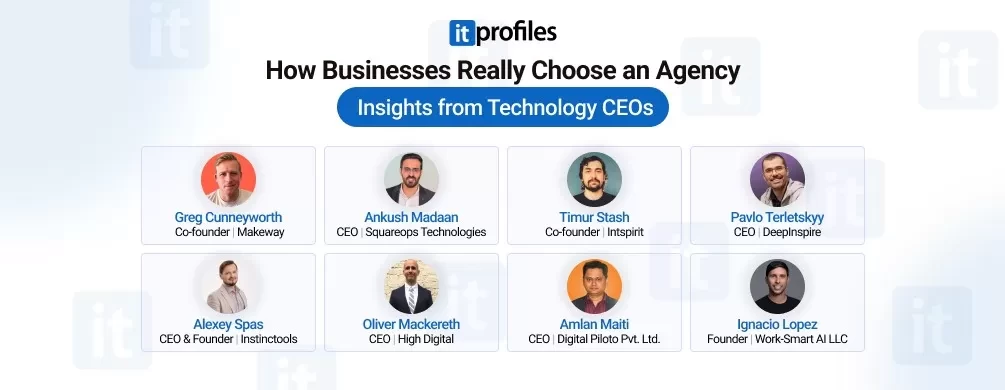
ITProfiles surveyed top technology CEOs and agency leaders to uncover what really influences tech agency selection beyond technical capability.
Finding a software development agency has never been easier or more overwhelming.
Whether a company is building a new SaaS platform, modernizing legacy infrastructure, implementing AI capabilities, or outsourcing engineering capacity, the market offers thousands of agencies promising remarkably similar outcomes. Their websites showcase polished case studies. Their teams highlight certified engineers, modern technology stacks, agile methodologies, and successful client engagements. Awards, testimonials, and industry badges have become standard features rather than meaningful differentiators.
For organizations evaluating specialized partners, such as mobile app development agencies, the challenge is often the same: many firms appear equally qualified on paper, making it increasingly difficult to identify which one is truly the best fit for the business.
From a buyer's perspective, the problem is no longer a lack of options. It is the abundance of seemingly qualified ones.
This creates a fundamental challenge. If multiple agencies demonstrate comparable technical expertise, similar portfolios, and competitive pricing, what ultimately separates the agency that wins from the one that loses?
It is a question that matters because agency selection is rarely just another procurement exercise. Choosing the wrong technology partner can delay product launches, increase costs, create operational disruption, and consume valuable leadership attention. The consequences extend well beyond the project itself. For many organizations, selecting an agency is ultimately a decision about business risk.
To better understand how those decisions are actually made, ITProfiles interviewed founders, CEOs, and senior technology leaders from software development agencies operating across different markets and industries. Each participant was asked the same core questions about how buyers evaluate agencies, what consistently influences final decisions, and how those decision-making processes are changing.
Although the participants represented different companies, client profiles, and geographical markets, their responses converged around a striking observation.
To complement the interviews, ITProfiles analyzed responses from participating technology CEOs and founders to identify areas of broad consensus. While individual experiences varied, several themes emerged consistently across the group.
| Question | CEOs Who Agreed |
|---|---|
| Is technical capability alone enough to win a software project? | 0% |
| Does understanding the client's business matter as much as technical expertise? | 100% |
| Is the deal often won before the proposal is written? | 75% |
| Do communication and discovery significantly influence buying decisions? | 100% |
| Will AI make human judgment a greater differentiator for agencies? | 87% |
Very few believed buyers consistently select the most technically capable agency.
Instead, the interviews suggest something more nuanced: technical competence has become the expected baseline. What increasingly differentiates agencies is their ability to reduce uncertainty before a single line of code is written.
That distinction changes how we should think about agency selection.
For years, the software services industry has focused on demonstrating capability. Agencies invest heavily in certifications, engineering talent, delivery methodologies, technical blogs, and project portfolios because these are visible indicators of expertise. Buyers certainly expect those qualities. But among agencies that have already earned a place on the shortlist, technical capability alone rarely resolves the final decision.
Instead, buyers begin evaluating something far less tangible.
Across the interviews, these questions appeared repeatedly, sometimes explicitly, sometimes indirectly, but always pointing toward the same conclusion. Buyers are not merely comparing software vendors. They are evaluating future working relationships under conditions of uncertainty.
The implications are significant for both sides of the market.
For technology buyers, selecting an agency requires looking beyond polished presentations and technical credentials to assess how a potential partner thinks, communicates, and collaborates.
For agencies, the findings suggest that differentiation increasingly depends on demonstrating commercial understanding, transparency, and judgment long before project delivery begins.
In other words, the real competition often starts well before the proposal is submitted.
For decades, agencies have competed primarily by demonstrating technical superiority.
Better engineers.
More certifications.
Larger development teams.
Broader technology expertise.
More successful projects.
The assumption has been straightforward: if buyers are choosing between agencies, the most technically capable one should naturally win.
The interviews tell a more complicated story.
Nearly every participating leader acknowledged that technical capability remains essential. No respondent suggested that expertise has become irrelevant. Without demonstrable competence, agencies rarely survive the initial evaluation process.
However, many argued that once buyers narrow their options to a small group of credible providers, technical differences become increasingly difficult to distinguish.
From the buyer's perspective, every shortlisted agency appears capable of delivering the required solution.
This changes the nature of the decision entirely.
One agency leader captured this shift succinctly by observing that clients are no longer purchasing code alone; they are purchasing confidence that the project will succeed. Another noted that agencies often lose opportunities not because they lack technical expertise, but because another firm made the buyer feel more certain about the outcome.
Those observations challenge a common assumption within the agency world.
Technical excellence remains necessary. It is simply no longer sufficient.
This aligns with how modern B2B purchasing decisions are increasingly made. Software projects are rarely approved solely by engineering teams. Procurement leaders, finance executives, product managers, operational stakeholders, and senior leadership frequently participate in vendor selection. Many of these decision-makers are not equipped or expected to compare software architecture, development methodologies, or engineering practices in depth.
Instead, they evaluate signals that are easier to interpret.
These become practical proxies for assessing delivery capability.
Several interviewees suggested that agencies often underestimate this reality. Marketing materials continue emphasizing programming languages, frameworks, certifications, and development processes because those achievements are tangible and measurable. Yet buyers may perceive those qualities as minimum expectations rather than compelling reasons to choose one agency over another.
As one respondent explained, once every agency claims senior engineers, agile delivery, cloud expertise, and successful case studies, those attributes cease to differentiate. They simply establish credibility to participate in the conversation.
That observation reflects a broader trend across professional services. Expertise increasingly functions as the cost of entry rather than a competitive advantage.
Consider how organizations hire legal counsel or financial advisors. Clients generally assume professional competence before initiating discussions. The final decision is more often influenced by confidence, responsiveness, strategic judgment, and the perceived quality of the working relationship than by technical credentials alone.
Software development appears to be following a similar trajectory.
Interestingly, not every participant agreed completely.
Some respondents emphasized that technical excellence remains decisive in highly regulated industries, complex enterprise environments, or projects requiring deep domain specialization. In these contexts, buyers may scrutinize architectural expertise, security practices, compliance experience, or specialized engineering capabilities far more closely than in standard commercial software projects.
This serves as an important reminder that context matters. The interviews do not suggest that technical capability has become unimportant. Rather, they indicate that its role has changed.
Technical expertise determines whether an agency earns serious consideration. It does not necessarily determine who wins.
That perspective was echoed across multiple interviews. Leaders from Intspirit, DeepInspire, SquareOps, and High Digital all suggested that technical competence has become an expected baseline among shortlisted agencies. As Timur Stash, Co-founder and Head of Development at Intspirit, summarized:
"Clients buy confidence, not code."
His observation foreshadows a broader theme repeated throughout the interviews: once buyers believe several agencies can build the solution, they begin evaluating qualities that are much harder to quantify.
One particularly insightful respondent described the buying process as less of a technical comparison and more of an exercise in reducing perceived risk. Buyers, they argued, often assume shortlisted agencies possess sufficient engineering capability. What they seek additional reassurance about is whether the chosen partner will communicate openly, adapt to changing circumstances, and consistently make sound decisions when inevitable project complexities emerge.
This perspective helps explain why agencies with exceptional engineering talent sometimes lose opportunities to competitors that appear, on paper, technically comparable.
The deciding factor may have little to do with software development itself.
It may instead reflect which agency demonstrated the strongest understanding of the client's objectives, acknowledged potential challenges honestly, and communicated with greater clarity throughout the evaluation process.
The distinction is subtle but important.
That shift has significant implications for agency positioning.
Technical content, certifications, delivery methodologies, and engineering credentials remain valuable because they establish competence. However, agencies that rely exclusively on these assets risk blending into a marketplace where nearly every serious competitor communicates similar messages.
Differentiation increasingly comes from demonstrating qualities that are harder to replicate: judgment, commercial awareness, transparency, and the ability to make buyers feel that complex projects will remain under control even when circumstances change.
This reframes the agency selection process.
Winning is no longer simply about proving that you can build the software.
It is about convincing buyers that your team is the one they can depend on when the project becomes difficult.
That distinction emerged repeatedly throughout the interviews, and it provides the foundation for understanding every subsequent theme explored in this analysis.
Share your project details with us for free, and get matched with experienced providers. Use our insights and expert recommendations to confidently choose the right partner for your needs.
Across the interviews, the answer wasn't "the best code."
It wasn't "the largest team."
It wasn't "the most impressive portfolio."
Instead, agency leaders repeatedly described the buying process as something much closer to risk management than vendor comparison.
That distinction changes almost everything.
From the buyer's perspective, software projects are not simply technology investments. They are business decisions involving uncertainty, internal politics, budgets, timelines, executive expectations, and careers.
A failed implementation doesn't merely delay a product launch. It can damage customer relationships. Reduce investor confidence. Create operational disruption.
And, perhaps most importantly, reflect poorly on the individual who recommended the agency in the first place.
Greg Cunneyworth, Co-founder and Managing Partner at Makeway, described this dynamic in particularly practical terms. Beyond technical expertise or portfolios, he believes buyers are quietly asking themselves a far more personal question:
"Will this company make me look good or make me look bad?"
That single observation reframes agency selection.
Buyers are not simply evaluating who can deliver software.
They're evaluating who they feel comfortable attaching their professional reputation to.
Intspirit expressed the same idea from another perspective.
Reflecting on deals his agency had lost, he observed:
"I'm thinking around the point that they choose the agency that feels like the lowest execution risk. Tech expertise rarely decides the deal."
Notice what isn't being said. Neither leader argues that technical expertise is unimportant. Instead, both suggest that once technical credibility has been established, buyers begin solving an entirely different problem.
They begin asking:
"Which of these agencies feels least likely to create problems six months from now?"
This is where many agencies misunderstand their own sales process. They assume they're competing on capability.
The interviews suggest they're competing on confidence.
Perhaps no respondent articulated this more clearly than Intspirit.
Asked what buyers evaluate that never appears in an RFP, Timur offered a remarkably concise answer:
"Clients buy confidence, not code."
He went on to explain that buyers are often trying to answer a question that is never explicitly asked:
"What will it be like to work with this team for the next 12 months?"
That question has surprisingly little to do with programming languages or cloud infrastructure.
It has everything to do with :
And the confidence that the agency will remain reliable when the inevitable challenges arise.
Pavlo Terletskyy, CEO and Co-Founder of DeepInspire, echoed this almost word for word.
Reflecting on deals his team had lost, he didn't conclude that competitors were necessarily stronger technically.
Instead, he offered a much simpler explanation:
"They probably felt safer with them. Not necessarily because they were better, but because they reduced uncertainty better."
That sentence may be one of the most important insights in the entire interview series.
It shifts the discussion from technical superiority to psychological certainty.
Oliver Mackereth, Founder of High Digital, described a similar pattern from another perspective. In his experience, buyers increasingly look beyond technical delivery and assess whether an agency genuinely understands the commercial objectives behind the project. That business alignment, he argued, often creates more confidence than another list of technical credentials.
One of the most interesting discoveries across the interviews is that trust isn't described as an emotional connection.
It's described as accumulated evidence.
Evidence that an agency will behave predictably.
Evidence that it understands the business.
Evidence that it communicates honestly.
Evidence that it makes good decisions under pressure.
DeepInspire summarized this beautifully when asked what buyers evaluate beyond portfolios and technical capability:
"How much risk they feel. Whether we understand the business context. And whether they can trust us when things get complicated."
Notice the sequence. Business understanding comes before trust. Trust comes before delivery. The relationship starts long before development begins. SquareOps offered another practical illustration.
Rather than trying to impress buyers with technical terminology, their CEO Ankush argued that expertise reveals itself through curiosity.
"Buyers judge your technical depth largely by the questions you ask."
He continued by explaining that thoughtful questions, those that anticipate risks buyers haven't yet identified, often communicate expertise more effectively than lengthy capability presentations.
That observation appears repeatedly throughout the interviews. Buyers don't necessarily trust agencies that have all the answers. They trust agencies that ask the best questions.
Another striking pattern emerged.
Very few participants described winning because they had the strongest technology stack.
Instead, they described winning because they demonstrated the strongest understanding of the client's business.
This distinction appears subtle. In practice, it's enormous.
Digital Piloto's CEO, Amlan Maiti, explained that what ultimately gives buyers confidence is not aggressive self-promotion but demonstrating genuine knowledge of the client's objectives.
As he put it:
"It's how deep your knowledge is about the services you are speaking about that gives confidence and encourages trust to the person on the other side."
Similarly, DeepInspire reflected on a successful engagement with remarkable simplicity:
"We showed that we understood the problem, the risks, and the path forward."
Not the technology.
The problem.
The risks.
The path forward.
That sequence mirrors how executives think about investments.
Technology is simply one part of a broader business decision.
When viewed collectively, the interviews reveal something surprisingly consistent.
Many of the behaviours agencies celebrate internally- beautiful presentations, polished websites, exhaustive capability decks, lists of certifications matter far less than agencies often assume.
Work-Smart AI founder Ignacio Lopez put it bluntly:
"The deck and the demo. I've watched impressive demos lose to a plain conversation more than once."
Why?
Because, as he explained, while agencies are demonstrating software, buyers are asking themselves something entirely different:
"Can I trust these people to solve my problem?"
That observation aligns almost perfectly with responses from Makeway, DeepInspire, Intspirit, and SquareOps.
Each, independently, described buyers evaluating confidence, understanding, or execution risk rather than simply technical excellence.
Together, they reveal a broader pattern.
Trust is not the destination.
It is the mechanism buyers use to reduce uncertainty.
And uncertainty, not capability, is what agencies are ultimately competing against.
For organizations evaluating software development partners, these interviews suggest that technical due diligence remains essential, but it is only the beginning of the evaluation process.
Once several agencies demonstrate credible engineering capabilities, buyers may benefit from shifting their attention toward different questions:
Which agency demonstrates the clearest understanding of our business?
Who asks questions that improve our thinking rather than simply collect requirements?
Who acknowledges uncertainty honestly instead of promising certainty?
Who explains risks before we discover them ourselves?
Which team would we still feel comfortable working with if the project encountered serious challenges?
These are difficult questions to score in a procurement spreadsheet.
Yet, according to the leaders interviewed by ITProfiles, they are often the questions that determine who ultimately wins the contract.
Ask most agencies where deals are won, and many will point to the proposal.
They'll talk about polished presentations, carefully designed capability decks, competitive pricing, or persuasive demonstrations. Entire sales processes are built around refining these assets, often consuming dozens of hours before a proposal is finally delivered.
Yet one of the most surprising findings from the ITProfiles interviews is that many agency leaders believe the proposal rarely changes a buyer's mind.
Instead, it validates a decision that has already begun taking shape.
The answer isn't found in a PDF.
It's found in the conversations that happen weeks before it.
One pattern emerged repeatedly across the interviews.
Long before procurement teams compare pricing or technical architectures, buyers are already evaluating something far more difficult to quantify.
They are observing how an agency thinks.
Not what it says.
How it thinks.
These moments often appear insignificant.
Collectively, they shape the entire buying decision.
Ignacio Lopez, Founder of Work-Smart AI, offered perhaps the most revealing observation of the entire interview series.
Reflecting on why agencies lose opportunities despite technically strong proposals, he explained:
"The proposal doesn't convince them. It gives them something to justify the decision they already made."
That statement fundamentally changes how agencies should think about business development.
If buyers have already developed confidence or doubt during discovery conversations, then proposals become supporting documentation rather than persuasion tools.
The real sales process happens much earlier.
The importance of discovery wasn't limited to a single participant. Leaders from SquareOps, High Digital, and Intspirit all described early conversations as opportunities to demonstrate strategic thinking rather than simply gather requirements. Several suggested that buyers are quietly evaluating how agencies think, not just what they know.
Across the interviews, discovery wasn't described as an information-gathering exercise.
It was described as an opportunity to demonstrate judgment. Several CEOs independently emphasized that the questions an agency asks communicate more about its capability than the answers it gives.
SquareOps expressed this particularly well. Rather than attempting to impress buyers with technical terminology, the team believes expertise becomes visible through curiosity.
As their response suggested, buyers often assess technical maturity by evaluating the quality of the agency's questions, not merely the sophistication of its presentations.
This reflects an important shift in buyer expectations. Experienced executives already assume agencies know how to build software.
What they cannot easily determine is whether an agency understands their business well enough to build the right software.
That distinction separates implementation from partnership.
Makeway reinforced this idea from another angle.
He explained that buyers are evaluating whether an agency truly understands their goals, not simply whether it understands technology.
That understanding creates confidence because it suggests the agency will continue making sound decisions after the contract is signed.
One subtle but recurring theme across the interviews is that experienced agencies resist the temptation to provide immediate answers.
That may seem counterintuitive. Many agencies believe speed demonstrates competence. The CEOs interviewed by ITProfiles suggest the opposite. Respondents repeatedly described the importance of slowing down.
Only then discussing technology.
DeepInspire described successful engagements as those where the agency first demonstrated an understanding of the client's business context, risks, and objectives before discussing implementation.
This approach communicates something powerful.
It tells buyers that the agency is committed to solving the correct problem, not merely delivering the requested solution.
In practice, that often requires saying something buyers don't expect to hear.
"I don't think that's the right approach."
Ironically, that willingness to disagree respectfully often increases confidence rather than reducing it.
Because independent thinking is difficult to fake.
Communication appeared in almost every interview.
But not in the way many people expect. None of the CEOs defined good communication as simply being responsive or pleasant. Instead, they described communication as evidence of future delivery quality.
These abilities matter because software development is fundamentally collaborative.
Code is only one output. Decision-making is another.
One respondent observed that buyers often evaluate whether conversations feel structured and thoughtful because they assume future project meetings will feel the same.
Every interaction becomes a preview of the working relationship. In that sense, communication isn't merely a soft skill. It's a leading indicator of execution quality.
Several participants also challenged another common assumption.
Those agencies win by appearing flawless. Instead, they argued buyers increasingly value authenticity.
Admitting uncertainty.
Acknowledging limitations.
Discussing trade-offs openly.
Explaining what might go wrong.
This may seem risky.
Yet the interviews suggest the opposite. Overconfidence often creates suspicion. Transparency creates credibility.
Digital Piloto emphasized that confidence is earned through genuine expertise and honest conversations, not exaggerated promises or rehearsed sales messaging.
Similarly, Intspirit argued that buyers naturally become more confident when agencies communicate realistic expectations instead of ideal scenarios.
These observations point toward an important psychological principle.
Confidence doesn't come from projecting certainty.
It comes from demonstrating sound judgment despite uncertainty.
One of the unintended consequences of AI and modern proposal tools is that producing an attractive proposal has become easier than ever.
Increasingly, these can be generated quickly.
The interviews suggest buyers recognize this. As proposals become more polished across the industry, they lose some of their power to differentiate. Conversations, however, remain much harder to automate.
A thoughtful discussion.
An unexpected question.
A challenge to an assumption.
A commercially insightful observation.
These moments cannot be copied from templates.
They reveal how an agency thinks.
And according to many interviewees, that is precisely what buyers are trying to evaluate.
For agency leaders, perhaps the most important implication is this: Stop treating discovery as preparation for the proposal. Treat discovery as the proposal.
Every meeting communicates something.
Every question signals expertise.
Every explanation demonstrates judgment.
Every difficult conversation builds or erodes confidence.
By the time the formal proposal arrives, buyers are often looking for confirmation that their instincts were correct. Not a reason to change them. That doesn't diminish the importance of a well-crafted proposal.
It simply places it in the correct sequence.
Confidence comes first.
Documentation comes second.
For years, agencies have worked to convince buyers that they possess better developers, stronger processes, or deeper technical expertise.
The interviews suggest buyers are asking a different question altogether.
Not:
"Can you build this?"
But:
"Do you understand why we're building it?"
That difference may explain why technically stronger agencies sometimes lose to competitors that appear, on paper, remarkably similar.
Throughout the interviews, respondents repeatedly returned to business understanding not as a pleasant extra, but as the foundation for everything else.
The same principle extends beyond software projects. Whether a business is selecting a software development partner or evaluating an SEO agency, decision-makers increasingly favor teams that understand commercial objectives rather than simply executing a list of deliverables.
Trust.
Communication.
Strategy.
Even pricing.
All of them become easier when an agency genuinely understands the commercial problem behind the software.
One of the strongest patterns across the interviews is that buyers appear to reward agencies that demonstrate understanding before demonstrating capability.
That order matters.
Capabilities can be listed on a website.
Understanding has to be demonstrated in conversation.
Intspirit described successful sales conversations as those where buyers quickly conclude:
"These people understand our business, ask the right questions, and I can imagine working with them for the next year."
Notice what earns confidence.
Not certifications.
Not frameworks.
Not awards.
Understanding.
Similarly, DeepInspire reflected on why his agency had won opportunities despite not always being the obvious choice.
His explanation was remarkably simple:
"We showed that we understood the problem, the risks, and the path forward."
That sentence captures something larger.
Software projects don't fail because teams misunderstand Java or Kubernetes.
They fail because teams misunderstand the business.
When agencies demonstrate they understand both, buyers begin believing they'll continue making good decisions after the contract begins.
Not every leader believed technical capability was fading into the background.
Alexey Spas, Chief Executive Officer at Instinctools, argued that in complex enterprise environments, particularly those involving regulated industries, large-scale integrations, or demanding architectural requirements, buyers continue to scrutinize technical depth carefully. While trust and communication remain essential, he suggested that demonstrable engineering capability still becomes the deciding factor when projects involve significant technical risk.
Rather than contradicting the broader findings, Alexey's perspective adds an important nuance: the more technically complex the engagement, the more likely buyers are to evaluate both confidence and capability in equal measure.
Another interesting pattern emerged from several interviews.
Buyers don't necessarily want agencies that agree with them.
They want agencies confident enough to challenge assumptions.
Intspirit highlighted this when discussing the signals buyers evaluate outside formal RFPs.
According to Timur, buyers pay attention to agencies that:
"...challenge unrealistic assumptions instead of saying 'yes' to everything."
That willingness to disagree constructively is surprisingly powerful.
Anyone can promise delivery. Fewer agencies are prepared to tell a prospective client:
"I don't think that's the right approach."
Yet that may be exactly what sophisticated buyers hope to hear because disagreement demonstrates independent judgment. Blind agreement suggests dependence.
The distinction is subtle. The implications are enormous.
Perhaps the strongest individual response in the entire interview series came from Ignacio Lopez of Work-Smart AI.
He described why his proposals regularly outperform larger firms despite competing against agencies with substantially greater resources.
His explanation wasn't about AI.
Or pricing.
Or engineering.
It was about specificity.
"If I can swap the client's name out of your proposal and it still reads fine, you already lost."
Few observations better capture the central argument of this article.
Generic capability statements communicate almost nothing. Specific understanding communicates everything. Lopez continued by explaining why. When buyers read a proposal that reflects their own language, their own challenges, and their own concerns, they conclude:
"This person actually listened."
Listening becomes evidence of understanding.
Understanding creates confidence.
Confidence reduces perceived risk.
The entire buying journey begins to fit together.
Another misconception challenged by the interviews is that agencies primarily compete through deliverables.
In reality, buyers increasingly appear to value thinking.
DeepInspire's responses repeatedly emphasized clarity.
Intspirit focused on judgment.
SquareOps highlighted thoughtful questioning.
Makeway described helping buyers feel professionally safe.
Although each agency expressed the idea differently, they all pointed toward the same conclusion. The value agencies create increasingly comes before development starts. It comes from helping buyers make better decisions.
Sometimes that means recommending against unnecessary features.
Sometimes it means identifying risks that haven't yet been discussed.
Sometimes it means simplifying an overly ambitious roadmap.
Those contributions rarely appear in contracts. Yet they frequently determine whether contracts are signed.
One particularly interesting contradiction emerged. Digital Piloto argued that pricing often remains the deciding factor. That reflects the reality of many cost-sensitive markets. And they're probably right.
Price undoubtedly wins deals. But the broader interviews suggest something slightly different. Pricing dominates when buyers struggle to distinguish meaningful differences elsewhere.
Understanding changes that equation. When buyers believe one agency genuinely understands their business, price becomes only one variable among several.
Makeway hinted at this when describing the emotional calculation buyers make.
Ultimately, buyers ask themselves:
"Will this company make me look good or make me look bad?"
An agency that reduces that anxiety frequently gains pricing power. Not because it is cheaper. Because it feels safer.
Easily connect with top-qualified providers for your project. Post your requirements for free, and let our data-backed insights and experts match you with the best service providers.
The final interview question asked participants to imagine agency selection only a few years from now. Despite differences in geography, company size, and specialization, an unexpected consensus emerged.
Most participants believe Artificial Intelligence will fundamentally change how buyers evaluate agencies. But not in the way many people assume. Very few predicted buyers would stop caring about expertise. Instead, they argued expertise will become easier to imitate.
AI can already generate proposals.
Produce architecture diagrams.
Write documentation.
Generate code.
Summarize requirements.
Create polished presentations.
The visible signals of competence are becoming increasingly accessible. That changes what buyers value.
Ignacio Lopez summarized the coming shift perfectly.
"AI made it cheap to look capable."
That single sentence may explain why traditional agency marketing is becoming less effective.
Increasingly, anyone can generate them. The result?
Buyers become more skeptical. Not less. They begin asking for evidence. Not a presentation.
Oliver Mackereth also suggested that as AI lowers the barrier to producing software and marketing materials, agencies will need to differentiate through commercial insight, strategic thinking, and the quality of client relationships rather than technical outputs alone.
Several participants independently arrived at exactly the same prediction. Intspirit believes technical execution will become increasingly commoditized as AI accelerates software delivery.
The differentiator becomes:
Judgment.
Knowing:
When AI should be used.
When it shouldn't.
How to balance speed with quality.
How to make difficult architectural decisions.
How to prioritize long-term maintainability over short-term convenience.
DeepInspire reached a strikingly similar conclusion. By 2027, Pavlo believes buyers will increasingly look for:
"Proof of judgement. Not just delivery capacity, but the ability to challenge assumptions and make the right technical decisions."
Notice how closely that aligns with earlier sections. The future doesn't reject trust. It explains where trust comes from. Judgment.
Work-Smart AI predicts another important shift.
Rather than asking agencies what they can build, buyers will increasingly ask what they have already proven. As Lopez explained:
"They'll want to know what you actually shipped, what it measurably saved, and whether you can prove the numbers are right."
That observation mirrors broader trends across enterprise procurement. Claims are becoming cheaper. Evidence is becoming more valuable. Agencies that can demonstrate measurable business outcomes, not simply completed projects- are likely to strengthen their position.
Despite the excitement surrounding AI, one reassuring theme emerged. None of the CEOs interviewed believe relationships disappear.
Quite the opposite.
As AI automates routine execution, human judgment becomes more valuable.
Business understanding.
Communication.
Architecture.
Strategic thinking.
Stakeholder management.
Decision-making.
These qualities cannot be commoditized as easily as code generation. Ironically, AI may increase the importance of the very qualities buyers already value today.
At first glance, the software development market appears to reward technical excellence above everything else.
Agency websites emphasize engineering talent, certifications, frameworks, delivery methodologies, and impressive client portfolios. Procurement checklists often reinforce the same priorities, asking vendors to demonstrate technical competence through case studies, technology stacks, security practices, and delivery processes.
Those factors unquestionably matter. Without credible technical capability, agencies rarely reach the shortlist. Yet the conversations with eight founders, CEOs, and technology leaders suggest that technical capability is increasingly the beginning of the evaluation, not the end of it.
Once several agencies satisfy that baseline, buyers begin making a fundamentally different decision. They stop asking:
"Who can build this?" And start asking: "Who do we trust to navigate everything we can't predict?"
That distinction reshapes the entire agency selection process. Throughout these interviews, participants rarely described winning because they possessed dramatically stronger engineering teams.
Instead, they spoke about winning because buyers believed they would ask better questions, understand the business more deeply, communicate more honestly, manage uncertainty more effectively, and make sound decisions when projects inevitably became more complicated than originally planned.
In other words, buyers weren't comparing software vendors.
They were comparing future partners.
That shift explains why seemingly small moments asking an insightful question during discovery, admitting uncertainty rather than pretending certainty, challenging unrealistic assumptions, or demonstrating a genuine understanding of the client's commercial objectives can outweigh polished proposals or lengthy capability presentations.
These moments are difficult to score in procurement matrices. Yet they often become the signals buyers remember most. Collectively, the interviews point toward a broader evolution in how professional services are purchased. For many years, agencies differentiated themselves by proving they could build software.
Today, the most successful agencies increasingly differentiate themselves by proving they understand businesses. As AI accelerates software development and makes many visible signs of technical competence easier to replicate, this distinction is likely to become even more important.
Beautiful proposals can be generated.
Architecture diagrams can be automated.
Code can increasingly be assisted by intelligent tools.
What remains difficult to automate is judgment.
Understanding context.
Navigating ambiguity.
Balancing competing priorities.
Making difficult trade-offs.
Helping executives make better decisions before development even begins.
Ironically, the rise of AI may make the human qualities revealed throughout these interviews not less valuable, but considerably more so. For agencies, the message is clear. Technical excellence remains essential.
But expertise alone is unlikely to create a meaningful competitive advantage if every serious competitor appears equally capable. The agencies most likely to win tomorrow will be those that demonstrate commercial understanding, communicate transparently, challenge assumptions thoughtfully, and consistently reduce uncertainty throughout the buying journey.
For technology buyers, the interviews offer an equally valuable reminder. Shortlisting agencies based on technical capability is a sensible starting point. Choosing a long-term partner requires looking beyond credentials. Pay close attention to the questions an agency asks before discussing solutions.
Notice whether conversations focus on your business rather than their capabilities. Evaluate how openly risks are discussed.
Observe whether they explain trade-offs clearly or simply agree with every request. These interactions reveal far more about the future relationship than even the most polished proposal.
Ultimately, perhaps the most important finding from these interviews is also the simplest.
And in today's software industry, that confidence may be the most valuable service an agency can offer.
Post a project for free and quickly meet qualified providers. Use our data and on-demand experts to pick the right one for free. Hire them and take your business to the next level.

ITProfiles is your trusted resource for finding the best IT companies for your development projects.
Built with love by diverse teams based in Denver (CO), Berlin (Germany), India, and Finland.