
Technology buyers are changing how they evaluate agency partners. The services they need may look familiar, software development, AI, automation, analytics, customer experience, but the questions being asked before an engagement are becoming harder to answer with a portfolio or a polished pitch. Buyers increasingly want to know what an agency can prove, how it manages risk, who will actually deliver the work, and whether its technology decisions can produce measurable business value.
ITProfiles spoke with agency founders and technology leaders across different markets to understand what they are hearing from buyers today and which emerging expectations agencies may still be underestimating. Their responses reveal a market in transition.
Buyers are asking for "demonstrable proof of outcomes and ROI up front," according to Bhupendra Chopra of Kanerika, while Shaun Randhawa of Unizen Group says prospective clients increasingly want "detailed evidence and guarantees, not assurances." The common thread is not simply greater demand; it is a growing demand for evidence.
That shift matters because agencies themselves appear divided on how quickly the market is changing. 96% of the leaders interviewed believe many agencies are falling behind or "reacting too late," while the one also describes the industry as failing to keep pace with changing expectations. Yet their answers do not point to one technology as the obvious solution. Artificial Intelligence features prominently, but so do data and analytics, automation, customer experience, specialization, transparency and business outcomes. The more revealing story lies in how these trends connect.
The degree of concern is notable. 80% of the participating leaders said some or many agencies are falling behind in responding to changing buyer expectations, suggesting that the perceived gap is not limited to one type of agency or one technology category. At the same time, the responses point in different directions when it comes to what buyers value most.
That divergence is important: the market may be moving toward a common demand for greater value and accountability, even as agencies disagree about which capabilities will matter most.
The emerging buyer expectation may ultimately be less about what an agency offers and more about what an agency can demonstrate. Buyers want to see evidence that technology will work, that the people delivering it can be trusted, that risks have been considered and that the investment can create a meaningful outcome. In an increasingly crowded technology services market, that may be the shift agencies can least afford to treat as optional.


Find My Agency Takes only 2 mins, 100% free
 Table of Content
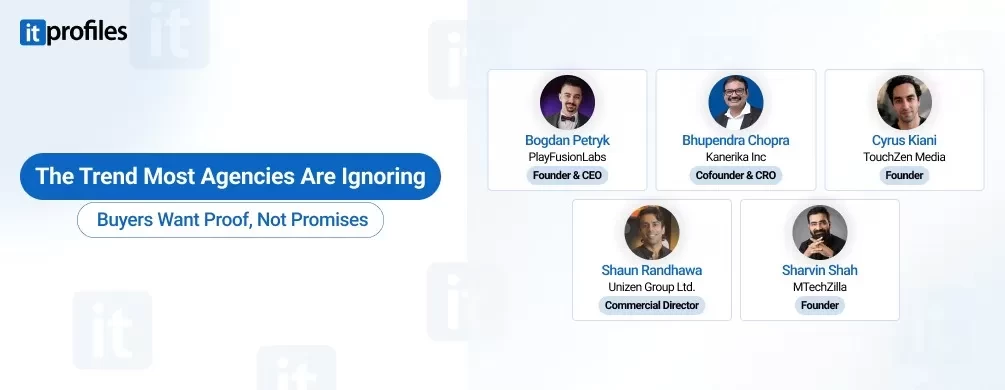
ITProfiles research reveals how buyer expectations are reshaping agency selection.
The interview responses reveal several clear signals about where buyer expectations are heading:
| Finding | Share of participating leaders |
|---|---|
| Believe agencies are falling behind changing buyer expectations | 80% |
| Identify AI & Automation as the leading area for agency investment | 40% |
| Say AI / AI hype is receiving more attention than it deserves | 80% |
| Say buyers prioritize innovation over reliability | 40% |
| Say buyers expect innovation and reliability equally | 40% |
| Say buyers prioritize reliability over innovation | 20% |
| Specifically identify measurable business outcomes/results as an increasingly important buyer expectation | 40% |
| Have invested in a capability before clients explicitly requested it | 100% |
The agency sales process has long rewarded strong portfolios, polished case studies and convincing claims about capability. But the responses suggest buyers are becoming more interested in what can be demonstrated than what can simply be presented. The shift is from asking whether an agency can deliver a software development project to asking whether the agency can show evidence that its work will create meaningful value.
That change is particularly visible in the growing emphasis on measurable outcomes. Bhupendra Chopra of Kanerika points to a
shift toward measurable business outcomes over deliverables
arguing that buyers increasingly evaluate agencies based on
the results they drive, not the volume of work produced.
This distinction matters because completed work is only an output. For a buyer, the more consequential question is whether that output improved the business in some measurable way.
The demand for evidence also extends beyond traditional ROI calculations. Shaun Randhawa of Unizen Group argues that agencies need to address buyers' focus on "revenue generation", noting that agencies can unlock new opportunities for clients but often fail to make that connection explicit throughout the buyer journey. At the same time, Bhupendra's experience with marketing analytics shows how measurement can become a differentiator when it is built into the relationship early. For buyers looking to connect technology investments with measurable performance, data and business intelligence are increasingly part of that evaluation.
His team moved toward analytics and automation after seeing decisions driven by "gut feel," and found that "clear attribution and faster reporting" became a reason clients chose to stay.
The implication is that agencies may need to rethink what they consider part of the deliverable. Reporting, attribution and outcome tracking can no longer be treated purely as post-project documentation if buyers increasingly use them to judge whether an agency deserves their continued investment. The more an agency can connect its work to business performance, the less dependent it becomes on subjective claims about quality.
The deeper change is therefore occurring in the question buyers are asking. Instead of treating delivery itself as the proof of value, they are increasingly looking for signals that connect an agency's work to the business case behind the investment. That also puts greater emphasis on the strategic decisions made before development begins, where digital strategy can determine whether technology investment is aligned with the business outcome being pursued.
Randhawa's observation that buyers are focused on their "propensity for revenue generation" is particularly revealing. It suggests that the agency is increasingly being evaluated not only as a technology supplier, but as a contributor to the commercial opportunity the technology is supposed to create.
There is also a broader warning for agencies that continue to emphasize activity over impact. Chopra describes the problem bluntly:
many agencies still sell activity rather than impact.
If buyers become more disciplined about connecting agency spending to commercial results, the traditional language of hours, features, deliverables and completed milestones may carry less persuasive weight on its own.
The shift is therefore not simply toward more reporting. It is toward a different standard of credibility. Agencies that can show how their work contributes to revenue, efficiency, customer outcomes or other defined business objectives give buyers something concrete to evaluate. Those that cannot may increasingly find themselves competing against providers that make their value easier to verify.
The demand for proof is closely connected to another change in the buyer-agency relationship: a lower tolerance for uncertainty. Buyers are not only asking what an agency can deliver; they increasingly want to understand how the work will be delivered, who will be responsible for it, what risks exist, and whether the agency is prepared to make those realities visible rather than hide them behind a confident proposal.
Sharvin Shah of MTechZilla sees this most clearly in questions about the delivery team itself. He says buyers increasingly want to know
who exactly will be working on this, and will it stay the same team.
That question exposes a gap that has existed in agency relationships for years: the people presented during the sales process are not always the people who ultimately deliver the work. Shah argues that agencies can lose trust when they
sell the pitch team and quietly staff the actual work differently once the contract is signed.
For buyers, transparency about the delivery team is therefore not a minor operational detail; it can become a measure of whether the agency's promises are credible.
The same expectation is beginning to extend beyond people and into the mechanics of delivery. Looking toward 2028, Randhawa expects buyers to demand
more transparency on the details of how services and products are delivered.
His prediction reflects a broader change in how organizations are structuring technology work, with companies increasingly balancing internal teams against external specialists. As that model becomes more complex, buyers may need greater visibility into what an agency is actually responsible for, where external expertise creates value, and whether the economics of outsourcing continue to make sense.
Transparency also has a financial dimension. Shah predicts that buyers will increasingly expect "real financial transparency" and evidence of "growth, client retention, how the business is actually doing." For organizations evaluating external technology partners, IT consulting can also play a role in assessing technology decisions, operating models and the risks attached to them.
The significance is not that buyers suddenly need access to every detail of an agency's finances. Rather, financial health can become another proxy for delivery risk. A technology partner that appears impressive during procurement but lacks the stability to support a long-term relationship creates a different kind of risk, one that may not appear in a portfolio or technical proposal.
One of the less obvious findings in the responses is that this demand for business understanding does not necessarily mean agencies need to become broader. In fact, one leader argues almost the opposite: agencies should become more precise about the problems they solve. Another points to data and analytics as an area where agencies can uncover operational insights that buyers may not initially recognize as part of a technology engagement.
The implication is that specialization may increasingly be defined not by an industry label alone, but by an agency's ability to understand a specific business problem deeply enough to uncover value the buyer has not yet articulated.
For agencies, the implication is that predictability may increasingly come from exposing uncertainty rather than pretending it does not exist. Buyers cannot eliminate every technical, commercial or operational risk, but they can choose partners that acknowledge those risks early and explain how they will be managed. The more complex the technology engagement becomes, the less credible a promise of frictionless delivery may appear compared with a clear explanation of assumptions, responsibilities, limitations and contingencies.
This is also why transparency is emerging as something broader than communication. It touches the people delivering the project, the processes behind the service, the economics of the relationship and the evidence supporting the agency's claims. Buyers may increasingly view these details not as information they receive after signing a contract, but as part of the decision about whether the agency deserves the contract in the first place.
The agencies that adapt to this expectation will not necessarily eliminate uncertainty. Instead, they will make uncertainty easier for buyers to see and evaluate. That distinction could become increasingly important as technology engagements become more sophisticated and buyers become more accountable for the outcomes of the partners they select.
Share your project details with us for free, and get matched with experienced providers. Use our insights and expert recommendations to confidently choose the right partner for your needs.
The shift from promises to proof is also changing what buyers expect from the agency itself. Technical execution remains important, but the interviews suggest that buyers increasingly value agencies that can understand the business problem behind a technology requirement. The question is becoming less about whether an agency can build a particular product and more about whether it understands why that product needs to exist in the first place.
The responses also caution against assuming that every buyer is moving in exactly the same direction.
On the question of whether buyers currently care more about innovation or reliability, 40% of respondents favored innovation, 40% believed buyers expect both equally, and 20% placed greater weight on reliability. Rather than weakening the broader argument, this split makes it more useful: buyers may disagree about which attribute comes first, but the responses suggest that agencies will increasingly need to demonstrate both the ability to innovate and the ability to deliver reliably.
Cyrus Kiani of TouchZen Media expects this change to become even more pronounced, predicting
more consulting and far less design/development
by 2028. His prediction points toward an agency model in which strategic input becomes a larger part of the relationship. Instead of waiting for a buyer to arrive with a fully defined specification, agencies may increasingly be expected to help clarify the problem, challenge assumptions and identify where technology can create the greatest value.
That requires a deeper understanding of the client's business rather than simply a broader technology stack. Shaun Randhawa argues that agencies should make sure their services solve "a problem that they care about" and produce a solution the agency understands how to bridge. Once that first problem is solved, he believes new and previously unknown problems can emerge, creating an opportunity for the agency to develop deeper expertise around the client's wider problem journey.
This perspective challenges the traditional positioning of agencies as broad, one-stop providers. The same logic applies across individual service categories, from web development to product engineering: breadth may get an agency onto a shortlist, but demonstrated understanding of the buyer's specific problem can determine whether it wins the work.
Randhawa observes that "too many firms" are focused on being generalists and recommends that agencies instead "focus on precision." Kiani similarly advises new agencies to establish "a real point of differentiation" by defining the specific niche and market they serve rather than presenting themselves as a generic design or development company.
For buyers, specialization can provide something that a long service list cannot: confidence that the agency has encountered similar business challenges before.
Bogdan Petryk of PlayFusionLabs offers a more fundamental interpretation of what buyers may increasingly expect from an agency: not simply a collection of capabilities, but
a cohesive, thinking organism that thinks strategically and does everything right.
His point moves the discussion beyond specialization alone. An agency can have deep technical expertise and still fail to create value if it cannot connect that expertise to the client's wider business problem. For buyers, the differentiator may therefore be the quality of thinking that sits behind the technology, whether the agency can connect data, operations, customers and commercial objectives into a coherent solution rather than simply delivering the requested feature.
The emphasis on business understanding also changes the role of the agency during the earliest stages of an engagement. If an agency is expected to contribute strategically, then discovery and onboarding cannot be treated as administrative formalities. They become opportunities to understand objectives, constraints, customers and commercial priorities before technology decisions are made. That is particularly relevant given Kiani's identification of "personalized onboarding" as a trend agencies are still underestimating.
The emerging model is therefore not necessarily one in which agencies do less technical work. It is one in which technical work sits inside a larger problem-solving relationship. Buyers may increasingly expect their agency partner to contribute before the specification is finalized, understand the commercial reason behind the project and remain accountable to the outcome rather than simply the deliverable. That would represent a meaningful shift in what it means to be a technology agency, from an executor of requirements to a partner in deciding which requirements are worth pursuing.
Trust has always mattered in agency selection, but the interviews suggest that buyers are becoming more specific about what trust actually means. It is no longer enough for an agency to have a recognizable name, an impressive portfolio or senior people leading the sales conversation. Buyers increasingly want visibility into the people, processes and evidence behind the promise, particularly once a project involves significant technical, financial or operational risk.
That expectation becomes particularly important when buyers are considering staff augmentation, where the individuals entering the client's delivery environment can directly affect continuity, accountability and project outcomes.
Sharvin Shah of MTechZilla identifies one of the clearest examples: buyers increasingly want to know,
who exactly will be working on this, and will it stay the same team.
In his experience, this can become a deciding factor rather than a routine staffing question. The concern is understandable. If the people presented during the sales process are different from those ultimately responsible for delivery, the buyer is effectively making a decision with incomplete information.
That gap can undermine confidence even when the agency itself has strong technical capabilities. Shah argues that some agencies
sell the pitch team and quietly staff the actual work differently once the contract is signed.
His response has been to allow clients to meet and vet the developers who will actually work on their projects. The broader lesson is that transparency about delivery is becoming part of the product buyers are purchasing. They are not simply buying access to an agency's capabilities; they are buying confidence in the team that will apply those capabilities.
Trust is also expanding into areas that traditionally remained outside the buyer-agency conversation. Shah predicts that by 2028, buyers will expect "real financial transparency", including evidence of "growth, client retention, how the business is actually doing." That does not necessarily mean buyers will demand unrestricted access to an agency's finances. It suggests instead that serious buyers may increasingly look for signals that a prospective partner is stable, accountable and capable of sustaining the relationship over time.
Randhawa sees another dimension of this shift in the way companies are combining internal and external technology resources. He predicts
more transparency on the details of how services and products are delivered
as organizations increasingly move between in-house and outsourced capabilities. For buyers, understanding where an agency's work begins and ends can become important not only for procurement, but also for long-term operating strategy. An external partner may be valuable today, but the buyer may eventually want to internalize part of that capability, or outsource an expensive internal function instead.
The deeper implication is that trust is becoming less abstract.
Buyers can test it through concrete questions:
Who is doing the work?
Will the team remain stable?
How is the service actually delivered?
What evidence supports the agency's claims?
How healthy is the business behind the pitch?
These questions shift trust from something an agency claims to have into something it has to demonstrate.
The agency relationship is also becoming part of what buyers are evaluating. Technical capability may get an agency onto a shortlist, but the interviews suggest that buyers are increasingly considering whether a partner can create value throughout the relationship, from onboarding and problem discovery to delivery, adaptation and the next challenge that emerges after the original project is complete.
That becomes particularly important in services such as mobile app development, where the initial build is only one part of a longer relationship involving iteration, performance, user feedback, maintenance and ongoing product decisions.
Cyrus Kiani identifies "personalized onboarding" as one of the trends agencies are still underestimating. That may sound like a relatively small operational detail, but it reflects a larger shift in expectations. A buyer entering an agency relationship does not necessarily want to be handed a standard process and asked to fit into it. The more strategic the relationship becomes, the more important it is for the agency to understand the client's goals, market, customers and constraints from the beginning.
Shaun Randhawa describes the relationship as something that should evolve with the client's problems. His recommendation is to begin with a problem that matters to the buyer, solve it effectively, and then use the resulting understanding to identify "new problems that were previously unknown." That creates a different model of agency growth. Instead of continually selling unrelated services, the agency builds deeper expertise by following the client's problem journey and finding where it can create additional value.
This approach also changes the meaning of specialization. Randhawa argues that agencies should
innovate with your clients, and build a positive feedback loop.
The agency learns from the first problem it solves, applies that knowledge to subsequent challenges and gradually develops expertise that can benefit other organizations facing similar problems. The relationship becomes valuable not because the agency offers everything, but because it becomes increasingly knowledgeable about a particular class of problems.
Petryk's perspective introduces a sharper warning about what happens when that deeper understanding is missing. He predicts an “ever-growing number of ‘dead’ projects”, particularly projects built around AI hype that ultimately prove useless because they were “garbage from the start.” His proposed antidote is equally direct: a viable project should begin with “analysis and a genuine understanding of needs,” rather than a polished image or a promise of rapid success. For buyers, this reinforces an important point: selecting an agency is increasingly about finding a partner capable of challenging weak assumptions before money and resources are committed, not simply finding one willing to build whatever has been requested.
As technology environments become more complex, buyers may also need specialized partners for areas such as automation testing, particularly when faster development cycles increase the pressure to maintain reliability.
The strongest partnerships, by contrast, may increasingly be those in which the agency can remain useful after the initial problem has been solved. That does not necessarily mean expanding the scope indefinitely. It means understanding when the client's needs have changed, identifying where the agency can genuinely contribute and being capable of adapting without losing accountability. In that sense, buyers may increasingly be selecting not simply for the agency's ability to complete a project, but for its ability to remain a valuable partner as the business moves to its next problem.
Easily connect with top-qualified providers for your project. Post your requirements for free, and let our data-backed insights and experts match you with the best service providers.
The predictions from the leaders interviewed point toward an agency market in which transparency, specialization, measurable value and strategic involvement become increasingly difficult to treat as differentiators. What is notable is that these expectations are not confined to one part of the buyer journey. They could affect everything from how agencies demonstrate credibility before a contract to how they structure delivery after the engagement begins.
One of the clearest predictions concerns visibility. Bhupendra Chopra expects buyers to demand "real-time transparency into performance and spend", with "always-on dashboards and proactive insights" replacing periodic reporting. Sharvin Shah anticipates a similar change from a different angle: buyers will increasingly expect "real financial transparency" and evidence of "how the business is actually doing." Together, these predictions suggest that transparency could expand from project reporting into a broader expectation about how an agency itself operates.
That visibility is particularly relevant as more businesses depend on cloud computing for scalable infrastructure, performance and cost control, making technology decisions increasingly tied to ongoing operational performance.
The relationship between agencies and their clients may also become more fluid. Shaun Randhawa expects
more transparency on the details of how services and products are delivered
as organizations increasingly combine internal and outsourced capabilities. Some companies may bring capabilities in-house after working with external specialists, while others may outsource expensive internal functions to take advantage of external expertise and economics. For agencies, that means the traditional assumption of a permanent vendor-client relationship may become less reliable. Partners will increasingly need to demonstrate why their role continues to create value as the client's operating model changes.
The agency's role could also move further upstream. Kiani predicts
more consulting and far less design/development,
suggesting that buyers may increasingly expect agencies to contribute to defining problems and making technology decisions rather than simply executing predetermined requirements. This would place greater value on business understanding, strategic thinking and the ability to challenge assumptions, capabilities that are harder to demonstrate through a conventional service catalogue.
The consequences of ignoring these shifts could also become more visible. Chopra warns that agencies that cannot "prove impact and offer transparency" will face "shrinking retainers and higher churn." Shah expects agencies without financial transparency to lose deals to competitors that can support their claims with numbers, while Petryk predicts an increase in "dead" projects where hype and attractive presentations obscure weak underlying propositions. These are different warnings, but they point toward the same future: buyers may become increasingly skeptical, and agencies may have to earn confidence through evidence rather than presentation.
The agency market of 2028, then, may not be defined by a single winning technology. It may be defined by a higher standard of accountability. Buyers could expect agencies to demonstrate measurable outcomes, explain how work is delivered, show who is responsible, understand the business problem, use emerging technology responsibly and make the economics of the relationship clear. Capabilities such as devops may increasingly be evaluated through this same lens, with buyers looking beyond technical implementation to reliability, deployment risk, scalability and operational performance. What is considered exceptional today could increasingly become part of the baseline for being considered credible.
The question is not whether buyers still care about technical capability. They do. The more important question is what buyers now need in addition to capability before they are willing to trust an agency with a meaningful business problem. Across the responses, the answer points toward a higher standard of evidence: buyers increasingly want to understand the value, risk, people and reasoning behind an agency's proposition rather than relying on a persuasive pitch alone.
That makes AI only one part of the story. Buyers may ask whether an agency can use AI, but they are also asking whether it can use it responsibly. They may want innovation, but they also want reliability. They may want a development partner, but they increasingly value someone who understands the business problem before turning it into a technical specification. And they may value a strong portfolio, but increasingly want evidence that the work produced something meaningful for the businesses behind those portfolios.
The strongest signal from the interviews is therefore a shift from agency claims to demonstrable confidence. Measurement, transparency, specialization, business understanding, delivery visibility and responsible technology adoption all serve the same underlying purpose: reducing the uncertainty involved in choosing an external technology partner. The agencies that recognize this shift can make those signals visible before buyers have to ask for them.
For buyers, the implication is equally important. A sophisticated agency-selection process should look beyond what a provider says it can do and examine how it proves that capability.
Who will actually deliver the work?
How does the agency define success?
Can it connect technical decisions to business outcomes?
How transparent is it about risks and limitations?
Does it understand the problem deeply enough to challenge the brief when necessary?
The agencies that answer those questions convincingly may gain an advantage that lasts beyond the next technology cycle. The differentiator is unlikely to be a single new capability that competitors cannot copy. It is the ability to make expertise, accountability and business value credible and verifiable.
That may be the trend many agencies are still underestimating: buyers are not simply looking for agencies that can promise a successful project. They are increasingly looking for agencies that can give them good reasons to believe it will succeed. By the time that expectation becomes universal, the agencies already building their businesses around evidence, transparency and measurable value may be several steps ahead.
Post a project for free and quickly meet qualified providers. Use our data and on-demand experts to pick the right one for free. Hire them and take your business to the next level.

ITProfiles is your trusted resource for finding the best IT companies for your development projects.
Built with love by diverse teams based in Denver (CO), Berlin (Germany), India, and Finland.