
For years, Clutch has been one of the best-known names in B2B research. It has helped buyers discover agencies, compare service providers, and gather client feedback in one place. That matters. When a business is searching for a partner, familiarity and scale can make a platform feel like the safest first stop.
When searching for a tech partner today, it’s easy to get lost in a sea of generic listings and noisy search results. ITProfiles offers a different path, combining AI-level precision with expert human analysis to cut through that noise. While traditional platforms like Clutch operate as massive, review-centric digital libraries where users must manually sift through thousands of entries, ITProfiles functions as a high-touch intelligence bridge.
This starts with Visibility, which is entirely organic and merit-based; there is no "pay-to-play" bias here. Instead of rankings influenced by sponsorship, the companies shown at the top are those verified as the best in the market through a proven fit across the entire web. This is amplified by Promotion, where a dedicated bot crawls the WWW to gather comprehensive data, forming the basis of a deep expert analysis for every profile. These insights, along with exclusive interviews, are shared directly with a global network of agents. Finally, the platform creates Opportunity by leveraging these international agents, who work directly with CIOs and enterprise directors to secure curated, pre-qualified projects. It is a shift from a simple directory to a personalized gateway for real enterprise growth.
The difference is not merely cosmetic. It affects how buyers shortlist firms, how confidently they move into outreach, and how likely they are to avoid costly hiring mistakes.


Find My Agency Takes only 2 mins, 100% free
 Table of Content

Before diving into the details, it helps to look at the platforms through the lens that matters most: how effectively each one supports a high-stakes technology decision. A directory is useful. A verified review system is useful. But when the decision involves software development, AI implementation, IT consulting, or a long-term delivery relationship, the buyer needs more than surface-level signals.
That is the core of this report. The comparison below is not about which brand is more famous. It is about which platform helps decision-makers make better decisions.
| Feature | ITProfiles | Clutch |
| Primary Data Source | Aggregates data from multiple leading B2B directories, plus company websites and public records. | Relies primarily on its own verified reviews and company claims. |
| Core Value Prop | Neutral Intelligence & Analyst Insight | Verified Reviews & Market Leaderboards |
| Review Bias Guardrails | High. Combines client feedback with objective data points (ITP Score) and analyst review to balance sentiment. | Moderate. Relies on verified reviews, but companies can influence visibility through "Clutch ranked" status. |
| Analyst Research & Context | Yes. In-depth interviews, trend analysis, and "Top 100" lists based on proprietary scoring. | Limited. Primarily directory-based. Some editorial content exists but is not core to the research process. |
| Search & Filter Depth | Deep filters by ITP Score, budget, industry, location, and specialized technical skills. | Robust filters by location, budget, industry, and client rating. |
| Data-Backed Scoring | Yes (ITP Score). A proprietary, algorithm-driven score combining multiple data signals for an unbiased health/quality metric. | No. Relies on average star rating and number of reviews. |
| Focus & Specialization | Deeply specialized in IT & Software Development companies. | Broad across 2,000+ business service categories. |
| Monetization / Bias | No ads. No pay-to-play bias. Companies cannot pay to influence their ITP Score. | Companies can pay for enhanced profiles and lead generation, potentially influencing visibility. |
| Total Provider Count | ~100,000 (specialized, vetted IT firms) | ~350,000 (across all business services |
Business leaders rarely regret having too much relevant information. They regret hiring too quickly, trusting the wrong signals, or basing an important partner choice on a narrow view of the market. In that sense, the quality of a sourcing platform depends on the depth of evidence it surfaces.
ITProfiles is positioned around that idea. Rather than relying only on a review-first lens, it brings together multiple data sources, analyst context, and structured scoring to give buyers a fuller view of each provider. The result is a more confident shortlist and a clearer understanding of why one firm appears stronger than another.
Several indicators illustrate why that matters.
These metrics matter because sourcing technology partners is not a consumer-style browsing exercise. It is a risk-management decision. The platform that reduces uncertainty will usually produce better outcomes.
A fair comparison should start with what Clutch does well. It remains a major player for a reason.
Those strengths should not be dismissed. For many companies, Clutch is a practical starting point.
But a strong starting point is not the same thing as the best decision tool.
The problem with a generalist directory is not that it lacks value. The problem is that its breadth can dilute its usefulness when the buyer needs precision.
One issue is ranking opacity. Buyers can see which companies appear near the top, but not always how those rankings are determined in practical terms. That creates a black-box effect. When the logic behind visibility is unclear, it becomes difficult to know whether a provider is appearing because it is truly a better fit or simply because it has stronger market presence, stronger marketing, or other visibility advantages.
Another limitation is the review-only mindset. Reviews matter, but they do not tell the full story. A company may have strong testimonials and still be a weak fit for a specific project type. A buyer evaluating a software development partner also needs to know about project history, market stability, portfolio strength, and the broader pattern behind the feedback.
Then there is the signal-versus-noise problem. Clutch spans many categories and many kinds of providers. That scale creates choice, but it can also make specialization harder to detect. For a founder or executive looking for a niche IT partner, broad coverage can feel less like clarity and more like an overload of options.
In other words, Clutch is useful for discovery. It is less effective when the task is a precise qualification.
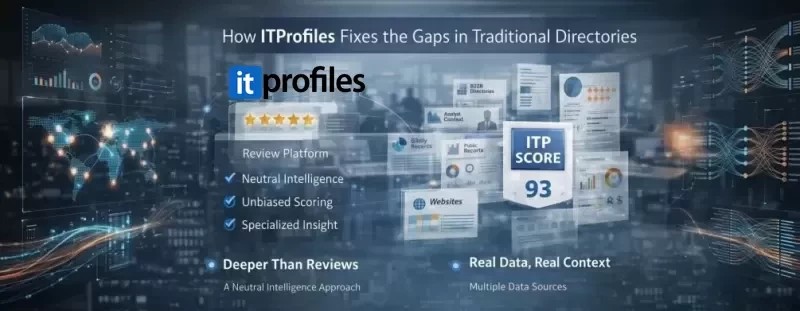
ITProfiles is built around the idea that technology sourcing should be based on neutral intelligence, not just reputation signals or review volume. Its value lies in how it connects multiple layers of evidence into one structured assessment.
A review platform gives a slice of the picture. That slice may be honest, but it is still only a slice.
ITProfiles takes a broader view. It aggregates data from leading B2B directories, company websites, and public records, then adds analyst context to interpret what the data means. That combination matters because raw information alone is not enough. Decision-makers need a synthesis that helps them understand how a company performs, what it is known for, and whether its profile matches the buyer’s needs.
This approach is especially useful in IT, where two firms can look similar on the surface but differ substantially in specialization, delivery quality, or market maturity.
The ITP Score is one of the strongest differentiators in the comparison. Instead of depending on unclear visibility rules, the score is designed to be data-driven and resistant to advertising influence.
That matters because buyers are not only looking for companies that have been reviewed. They are trying to identify companies that are actually strong in their category. A score that weighs client feedback, market reputation, public data, and portfolio evidence creates a more stable basis for comparison than a simple list of popular names.
For users, that means less guesswork and more confidence in the shortlist.
Clutch covers many sectors. That scale is useful, but it can also limit how deeply the platform addresses the nuances of IT service evaluation.
ITProfiles focuses specifically on technology firms, software development, AI, IT consulting, and related service categories. That narrower scope allows the research model to go deeper. Analyst interviews, curated lists, and category-specific evaluation make the platform more relevant to buyers who are not just looking for any vendor, but the right technical partner for a specific challenge.
That specialization matters. The criteria for evaluating a branding agency are not the same as the criteria for evaluating a custom software team or an AI implementation partner. A focused platform can reflect those differences more accurately.
Star ratings are a useful signal, but they are not enough on their own. A strong evaluation process needs context.
ITProfiles profiles are designed to surface more than a surface-level score. They can include portfolio examples, detailed project history, and analyst interpretation that help connect past work to future needs. That makes it easier to ask the right questions before outreach begins.
Instead of asking only, “Is this company well reviewed?” the buyer can ask, “Has this company handled work like mine before?” and “Does its broader profile support the kind of project I need?”
That shift is subtle, but it is decisive.
Share your project details with us for free, and get matched with experienced providers. Use our insights and expert recommendations to confidently choose the right partner for your needs.

Clutch remains a valuable platform. It has scale, credibility, and a strong review foundation. For broad discovery and early-stage research, it still serves a useful purpose.
But when the decision is high stakes, broad is not always better. Buyers choosing a technology partner need more than a list of companies and a visible review count. They need context, depth, and a way to separate true fit from polished marketing.
That is where ITProfiles has a stronger case.
By combining aggregated data, analyst insight, and an unbiased scoring model, ITProfiles is built for a more serious type of sourcing decision. It helps buyers move beyond surface impressions and make choices they can defend internally.
The difference is simple: Clutch helps people browse. ITProfiles helps them decide.
Stop relying on reviews alone. Start making decisions with data.
1. Is Clutch reliable?
Yes. Clutch is a reliable source for verified client reviews and broad provider discovery. Its limitation is not a lack of trustworthiness in a general sense, but rather a lack of objectivity in ranking and depth of decision support. For users who need a more analytically driven evaluation process, ITProfiles offers a more specialized alternative.
2. Does ITProfiles have as many companies as Clutch?
Clutch may have a larger total number of providers across many categories. ITProfiles focuses on depth over breadth, with a highly curated database of IT service providers that surfaces the most relevant and qualified firms for software development and IT consulting searches.
3. How is the ITP Score calculated?
The ITP Score is a proprietary algorithm that weighs multiple factors, including aggregated client feedback, market reputation indicators, public business data, and portfolio strength. The goal is to create a holistic quality metric rather than a single-review snapshot.
4. Can a company pay to improve its ranking on ITProfiles?
No. Rankings and scores are intended to remain unbiased and are not altered through payment. That independence is part of the platform’s value proposition.
5. Which platform is better for finding a niche development agency?
ITProfiles is typically the stronger choice for niche searches because it is built around IT specialization, deeper filters, and contextual evaluation. Clutch may be useful for broader discovery, but ITProfiles is designed to improve precision.
Easily connect with top-qualified providers for your project. Post your requirements for free, and let our data-backed insights and experts match you with the best service providers.
GoodFirms vs. ITProfiles: Why Curated Data Beats Generalist Directories
Designrush vs ITProfiles: Deciding between the visibility of a digital billboard and the precision of an intelligence bridge.
Post a project for free and quickly meet qualified providers. Use our data and on-demand experts to pick the right one for free. Hire them and take your business to the next level.

ITProfiles is your trusted resource for finding the best IT companies for your development projects.
Built with love by diverse teams based in Denver (CO), Berlin (Germany), India, and Finland.